For generations, the Western world has dismissed cultural appropriation with the casual defence that “imitation is the sincerest form of flattery.” But when a dominant culture strips an ancient heritage of its sacred origins, rebrands it for profit, and claims ownership over it, it ceases to be a compliment. Instead, cultural appropriation reveals itself as a modern manifestation of racism and colonial erasure.
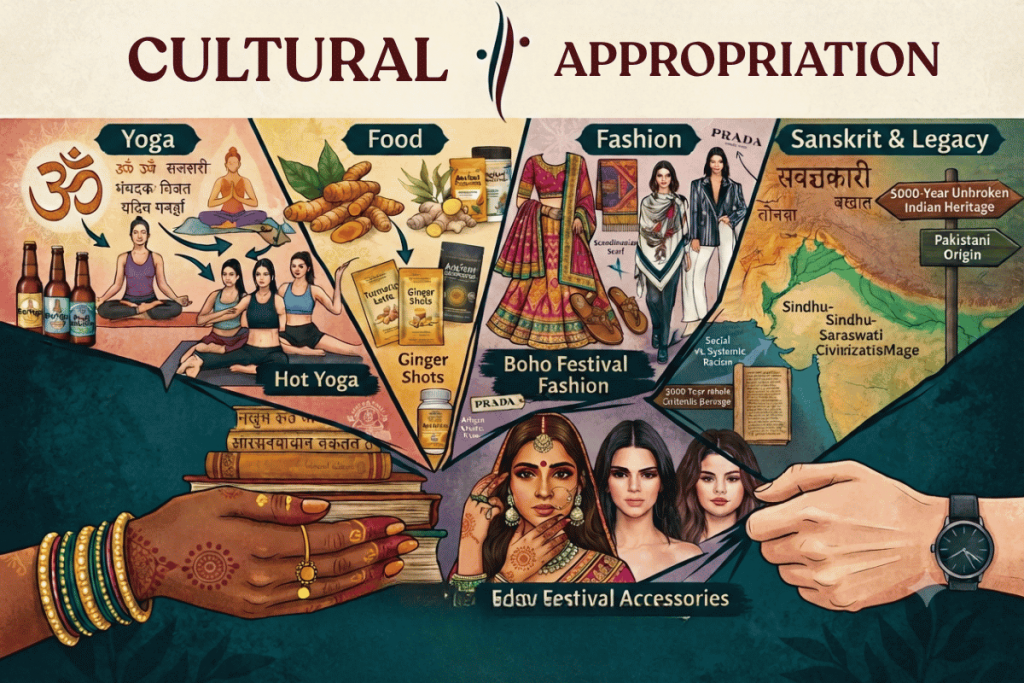
When viewed from an Indian-Hindu (Bhāratiya) perspective, this phenomenon systematically dismantles and exploits a 5,000-year-old unbroken civilisation across five core domains.
Yoga is a sacred gift to the world from India. It is a holistic, synergistic discipline of mind, body, and spirit, fundamentally designed to elevate physical health while connecting the inner self to the Supreme.
Today, Western commercialism has divorced Yoga from its Vedic and Hindu roots. The practice is widely stereotyped as an aesthetic trend for affluent Western demographics wearing fashionable athletic apparel. More concerning are commercial distortions like “hot yoga,” “speed yoga,” and “beer yoga.” These bizarre trends trivialise ancient spiritual practices. By systematically anglicising the terminology, Western companies like Hot Pod Yoga, BierYoga, Bendy Brewsky, etc., to name a few, are aggressively rebranding a profoundly Bharatiya spiritual science into a Western fitness commodity.
The Islamic world has a complex relationship with yoga. On one hand, some conservative religious figures consider yoga to be haram and have called for it to be boycotted because of its association with Hindu spirituality, beliefs and practices. On the other hand, many more moderate or progressive Muslims have embraced yoga for its physical and mental health benefits. In some cases, however, this has involved removing or avoiding traditional Hindu elements, such as Sanskrit names, mantras, and meditation, and replacing them with Islamic terminology or practices. These adapted forms are sometimes referred to as “Islamic yoga” or Muslim-friendly yoga.
Ancient Indian-Hindu wellness knowledge is routinely appropriated under the guise of Western “health fads.” Culinary and medicinal remedies deeply rooted in Indian-Hindu households for millennia, such as haldi (rebranded as turmeric lattes) and ginger infusions (sold as ginger shots), are packaged by Western corporations as novel discoveries.
Similarly, ancient Ayurvedic adaptogens like Ashwagandha have become ubiquitous fixtures in health-conscious Western households. This commercialisation occurs without any due credit or financial equity to the culture that cultivated this knowledge.
Historically, Western entities have even attempted to legally patent and monopolise these traditional Indian remedies, prioritising corporate profit over indigenous intellectual property. The
University of Mississippi Medical Center tried to patent Turmeric and turmeric-based remedies. This patent faced fierce opposition from India, and after a prolonged fight, successfully had the patent revoked. More recently, UK-based pharmaceutical company Nicholas John Larkins tried to patent ginger-based cold remedies
Global fashion houses frequently perpetrate blatant cultural plagiarism, causing both cultural devaluation and direct economic harm.
Recent internet trends have seen traditional Indian garments, like the dupatta and the lehenga, stripped of their identities and marketed transparently as “Scandinavian scarves” or “boho two-piece sets.” This erasure has drawn deep disbelief and outrage from Indians globally. Adding economic insult to cultural theft, luxury brands like Prada have showcased designs identical to the globally protected, Geographical Indication (GI)-tagged Kolhapuri chappals on international runways. They do so without providing a basic byline, credit, or compensation to the traditional, hereditary slipper craftsmen of Kolhapur, India.
In mainstream American media, celebrities like Selena Gomez and Kendall Jenner have popularised the bindi and mehndi (henna) as trendy, “edgy” festival fashion accessories.
Had these public figures explicitly credited and respected the Indian roots of these symbols, it could have provided valuable cultural ammunition for women of Indian descent fighting systemic racism. Historically, the bindi has been used by racists to target, isolate, and harass Hindu women (such as the violent “Dotbusters” hate groups in the West). It represents a painful double standard when sacred symbols trigger discrimination against the people who inherit them, yet yield social capital and praise for Western influencers who adopt them arbitrarily.
For a long time, it was believed that India’s hallowed ancient history and scriptural legacy were too deeply rooted to be rewritten. However, the Vedic period, ancient Hindu scriptures, and the legacy of the Sindhu-Saraswati (Indus Valley) Civilisation face an emerging threat of geographic and political appropriation.
For decades, political and state narratives in Pakistan sought to distance the region from its historical Indian matrix, emphasising ancestral lineages tied to Arab, Persian, and Turkic cultures, alongside efforts to establish DNA connections exclusively to Central Asian steppe herders.
Paradoxically, a revisionist shift has emerged claiming Sanskrit, the Rigveda, and the Sindhu-Saraswati heritage as exclusively “Pakistani.” This narrative ignores a fundamental historical reality: while India and Bharat trace a documented, written, and unbroken civilisation spanning over 5,000 years, Pakistan as a nation-state and distinct political identity was established only 78 years ago, through the Partition of India in 1947. Geography cannot be separated from the continuous cultural and spiritual identity that preserved these traditions through millennia.
It is time to firmly reject the narrow Western framework that treats global cultures as a buffet to be sampled, renamed, and monetised. Indian-Hindu history, art, yoga, cuisine, traditions, and attire must be recognised, protected, and fully credited to their source. Adopting bits and pieces of a heritage while erasing its origin is deeply insulting to a country and a civilisation that has stood unbroken for over five millennia.