The report “Understanding the 2022 Violence in Leicester”, published by the School of Oriental and African Studies (SOAS) into the 2022 Leicester unrest, has been presented as an “independent inquiry.” However, independence is not a label that can simply be asserted; it must be demonstrated through transparent methodology, balanced evidence, and impartial authorship. This fact-check examines whether the SOAS’s Leicester Report meets those standards, analysing the composition of its panel, omissions within its findings, methodological weaknesses, and the broader evidentiary basis behind its conclusions.
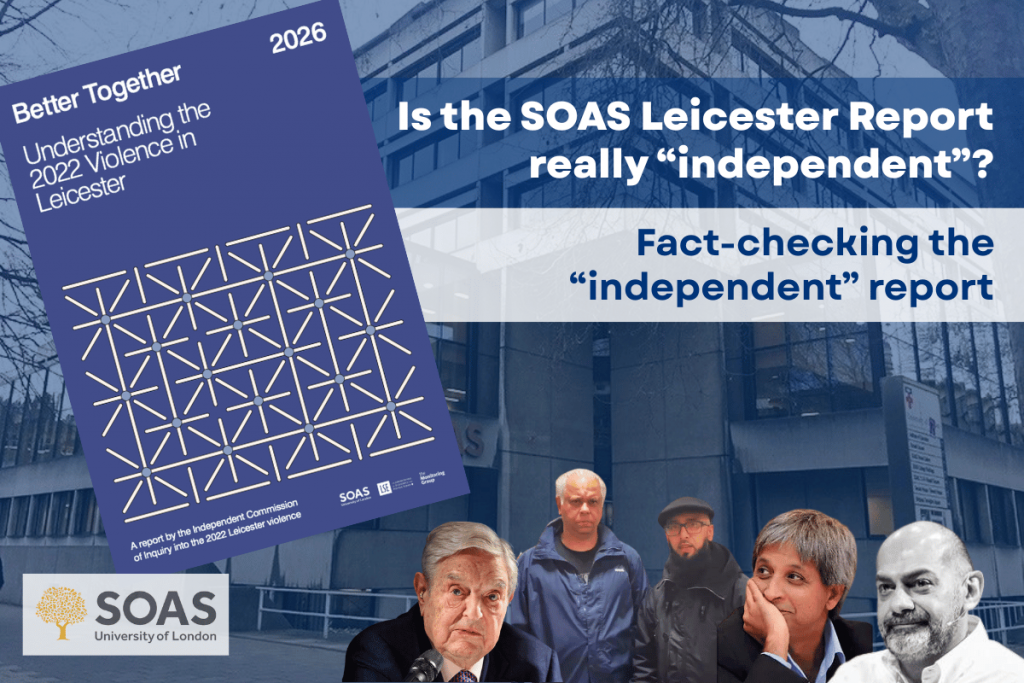
Fact-checking the “independent” report
1. Bias and Conflict of Interest among Panellists
- Predetermined Conclusions: The inquiry appeared to reach a predetermined conclusion, compromised from the outset by the previous public statements and recorded conduct of key panellists.
- Hostility Toward Hinduism: Report author Suresh Grover (The Monitoring Group) has a documented history of animosity toward the Hindu faith, including a previous proposal to project the sacred Hindu Aum symbol as a Nazi symbol onto the Houses of Parliament – deeply offensive to both Hindus and Jews.
- Political Bias: Authors Subir Sinha and Chetan Bhatt have been consistently outspoken against Hindu political expression (labelled dismissively as “Hindutva”), further undermining the report’s objectivity regarding the community’s right to self-protection.
- Selective Accountability: The report was heavily promoted by Islamist outlets like MEND and 5Pillars from its inception, suggesting a specific ideological alignment rather than a neutral academic pursuit.
2. Erasure of Key Figures
- The Omission of Majid Freeman: Despite being a central figure in spreading disinformation during the unrest and currently facing trial for the encouragement of terrorism, Freeman is not mentioned once. This omission suggests a conflict of interest, potentially due to his links with Suresh Grover and The Monitoring Group.
- Fixation on INSIGHT UK: In stark contrast to the silence on Freeman, the report contains 118 references to INSIGHT UK, perhaps a chaotic reflection on the writer’s mind. These references consist largely of vague, “woolly” attempts to link the organisation to various outside entities without substantive evidence.
- Ignored Incidents: The report fails to mention the bankruptcy of Mohammad Hijab and the court cases he lost related to the Leicester violence.
Related stories
- The not-so-independent SOAS inquiry into the Leicester violence
- How fake news was used to incite hate and attack Hindus in Leicester
3. Methodological Flaws and Data Imbalance
- Lack of Institutional Access: The inquiry suffered from a total lack of cooperation from key officials; the Leicestershire Chief Constable declined to engage and the City Mayor refused to meet the panel.
- Skewed Qualitative Data: Without official police datasets, the report relied on voluntary testimonies, resulting in a significant demographic imbalance: 43 interviews were conducted with Muslims compared to only 21 with Hindus – the biggest victims of the unrest. While they informed the media that over 281 Hindus contributed to the report, the involvement of internal members does not guarantee an objective perspective and often compromises the appearance of impartiality.
- Insignificant Survey Sample: The quantitative data is statistically weak, based on a survey of only 98 respondents, an insufficient sample size to draw meaningful conclusions about a city-wide conflict.
- Anonymity vs. Verification: Heavy anonymisation (e.g., “Interview XAC”) was used, but this effectively renders external peer review and verification of specific claims impossible.
4. Misrepresentation of Religious and Social Context
- Distorted Definitions: The report provides inaccurate definitions of Hindutva, misrepresents the significance of Hanuman flags, and frames ancient Hindu chants, used for centuries, as modern, provocative tools.
- Inaccurate Claims on Caste: The authors make “unhinged” links to foreign politics and provide irrelevant commentary on Caste, falsely claiming it is a core structure of Hindu sacred texts. This ignores the fact that “Caste” is a Portuguese-derived construct (castus), and this reference may serve to distract or deflect from documented Islamist activity in the UK.
- Lowering the Evidentiary Bar: The report explicitly uses a “balance of probabilities” standard (what a “person” might believe) rather than a rigorous criminal justice standard, allowing for speculative conclusions. The report itself is reduced to a collection of suppositions and conjectures.
5. Policing and the “Two-Tier” Narrative
- Unverified Claims of Disproportionality: Despite admitting they could not obtain official arrest and sentencing data, the authors claim there are “grounds for believing” in two-tier policing or the disproportionate arrest of Muslims.
- Unsubstantiated Trigger Events: The report highlights an incident involving an 18-year-old Muslim man who was allegedly attacked near Uppingham Road, but fails to provide evidence of the perpetrators’ identities or the events preceding the attack and what the Muslim man was doing. Or why the Police refused to follow up.
- The “May Incident”: The report uses a supposed beating of a Muslim man in May as a primary trigger for the violence, despite a total lack of evidence that the event occurred as described or was motivated by the religion of the perpetrators. The use of emotive language by the report, e.g., “Muslim boy” for an 18-year-old man, is odd and could lead to reader bias.
6. Failure of Recommendations
- Ignoring Radicalisation: The report fails to address the core issue of Islamists being “riled up” to attack Hindus. Consequently, it makes zero recommendations for training or educating Islamic leaders and organisations on how to prevent the spread of misinformation among their youth, a well-known and documented issue during the violence.
- Questionable Sourcing: The report regularly quotes the Federation of Muslim Organisations (FMO), a group that has previously faced criticism for attempting to hinder awareness regarding grooming scandals.
- Financial Motivation: Ultimately, the report avoids addressing the root causes of social cohesion failure, instead concluding with a standard request for more funding for “communities.”