The Green Party’s Hannah Spencer won the Gorton and Denton by-election held on 26 February 2026, marking the party’s first parliamentary by-election victory with a majority of about 4,400 votes over Reform UK, while Labour trailed into third place, a major upset in what had been a safe Labour seat.
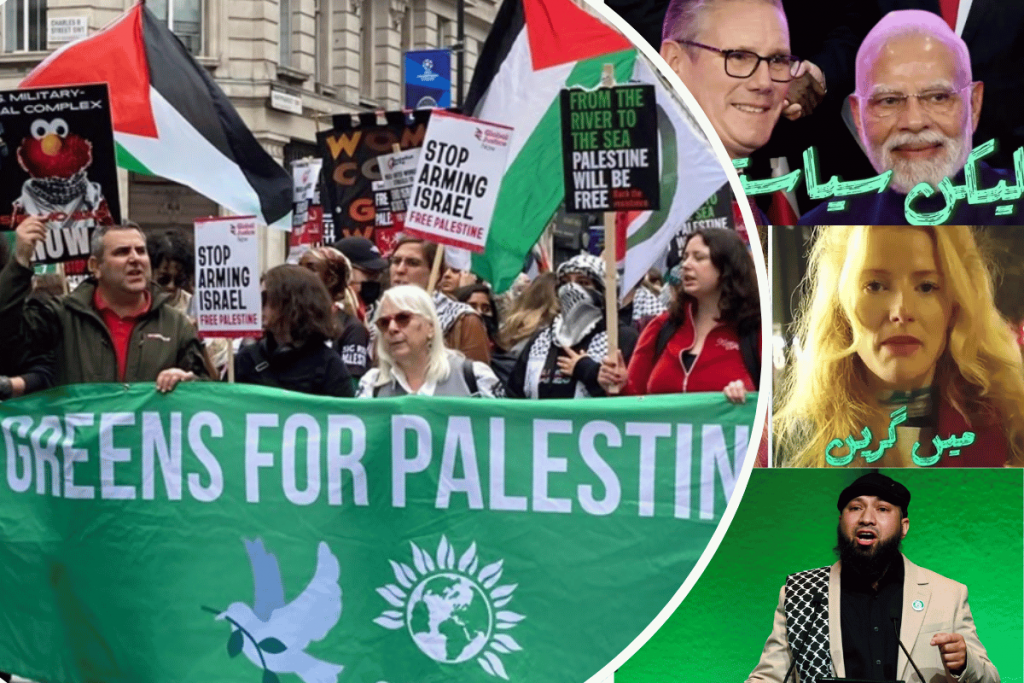
Observers say there were reports of illegal “family voting” at the Gorton and Denton by-election, a practice where two people enter a polling booth together, and one influences the other’s choice, breaching the secret ballot, prompting calls for investigation.
Gorton and Denton is a diverse, mostly urban Greater Manchester seat with a large Muslim community (around 27–40% in some areas) alongside young, lower-income and ethnically mixed voters. The Greens made Gaza and wider foreign-policy issues central to their campaign, producing leaflets and videos in Urdu to appeal to Pakistani Muslim voters dissatisfied with Labour’s stance, which was part of a broader strategy that helped them win the by-election
The Green Party of England and Wales has been accused of stirring up “anti-Hindu hatred” during the Gorton and Denton by-election. Trupti Patel, president of the Hindu Forum of Britain, said Zack Polanski’s party circulated an Urdu-language campaign video showing Keir Starmer shaking hands with Narendra Modi, which she claimed “exploited divisions within the South Asian diaspora. Therefore, the Greens are intentionally trying to divide Hindus and Muslims and spread hatred between communities.”
Nationally, the Greens have been pivoting from purely environmental issues toward broader economic and social justice messages, including strong pro-Palestinian positions and targeted outreach to urban, young and minority voters, to expand their appeal beyond traditional supporters. It is this cleavage (between urban young voters and the Muslim vote) which is so attractive [pardon the pun] to the Greens, who have been energised by their new brand of eco-socialist politics led by Zak Polanski.
A worrying trend towards sectarianism
Sectarianism is when political groups exploit religious, ethnic, regional, or ideological divisions to mobilise support by portraying other groups as threats or outsiders. Therefore, the recent by-election can be thought of as a textbook case of sectarianism in British politics – as the Greens targeted their campaigning at the large Muslim vote by campaigning on issues relevant to muslims (such as Gaza).
However, this is not the only case of sectarianism in the UK. The 2024 general elections saw many instances of sectarian politics.
- Shockat Adam won Leicester South in the 2024 general election by narrowly beating Labour’s Jonathan Ashworth with a pro-Palestinian, locally focused campaign that tapped into dissatisfaction over Labour’s Gaza stance and broader concerns, overturning a long-held Labour majority by 979 votes. About 37% of Leicester South residents are Muslim
- Ayoub Khan won Birmingham Perry Barr in the 2024 general election as an independent by overturning a large Labour majority to win by 507 votes, campaigning on a pro-Palestinian, locally-focused platform after leaving the Liberal Democrats. About 45% of people in the Birmingham Perry Barr seat identify as Muslim under the 2021 census estimates.
Why should this worry Britain?
Sectarianism should worry Britain because it deepens social divisions and undermines community cohesion, making it harder for people of different backgrounds to live together peacefully. As seen historically in places like Northern Ireland during their troubles, sectarian tensions can escalate into long-lasting political instability and violence if left unaddressed.
Globally, Hindus have often been victims of sectarian violence, especially in regions with religious and ethnic tensions. Attacks, forced expulsions, and communal riots in countries like Pakistan, Bangladesh, and Uganda have repeatedly targeted Hindu communities, leading to displacement, loss of property, and social upheaval.
Under Idi Amin, Uganda’s sectarian politics deliberately targeted the South Asian community, mostly Hindus and Sikhs, portraying them as economic and ethnic outsiders who were hoarding wealth and undermining local Ugandans. In 1972, Amin issued a decree ordering the expulsion of around 80,000–90,000 South Asians, seizing their businesses and properties, which forced them to flee the country almost overnight, creating a massive humanitarian and economic upheaval that reshaped Uganda’s demographics and economy for decades. Many displaced Hindus settled in the UK, particularly in Leicester.
In the late 1980s and 1990s, escalating insurgency and sectarian violence in Kashmir, India, created a climate of fear for the Hindu minority, particularly the Kashmiri Hindu Pandits. Militants targeted them through threats, killings, and intimidation, forcing around 100,000–150,000 Pandits to leave their ancestral homes and migrate to other parts of India, resulting in a mass displacement that uprooted centuries-old communities and disrupted their social, cultural, and economic life.
More recently, there have been multiple violent incidents against the Hindu minority, including the lynching of a Hindu garment worker whose body was beaten, hung, and set on fire after false blasphemy allegations, attacks on Hindu businessmen and families, and rising fears among minorities ahead of national elections
Rajiv Sinha (member and former candidate for the Green Party) has continuously targeted the Hindu community and India with malicious intent. It was reported that the recent Gorton and Denton by-election stirred anti-Hindu sentiment; it may only be a matter of time before a situation arises where sectarian tactics actively target Hindu’s more widely.
Worrying shift towards religious sectarianism
We should not forget the consequences of allowing sectarian politics to flourish. The Gorton and Denton by-election may seem minor, but it reflects a worrying shift toward mobilising voters along religious lines rather than shared national interests, a pattern that has historically deepened division, as seen in Northern Ireland during The Troubles.
For British Hindus, this trend should raise concern. Experiences such as the expulsion of South Asians from Uganda under Idi Amin show how quickly minority communities can become vulnerable when politics turns sectarian. Preventing such divisions is essential to preserving Britain’s tradition of pluralism and social cohesion.