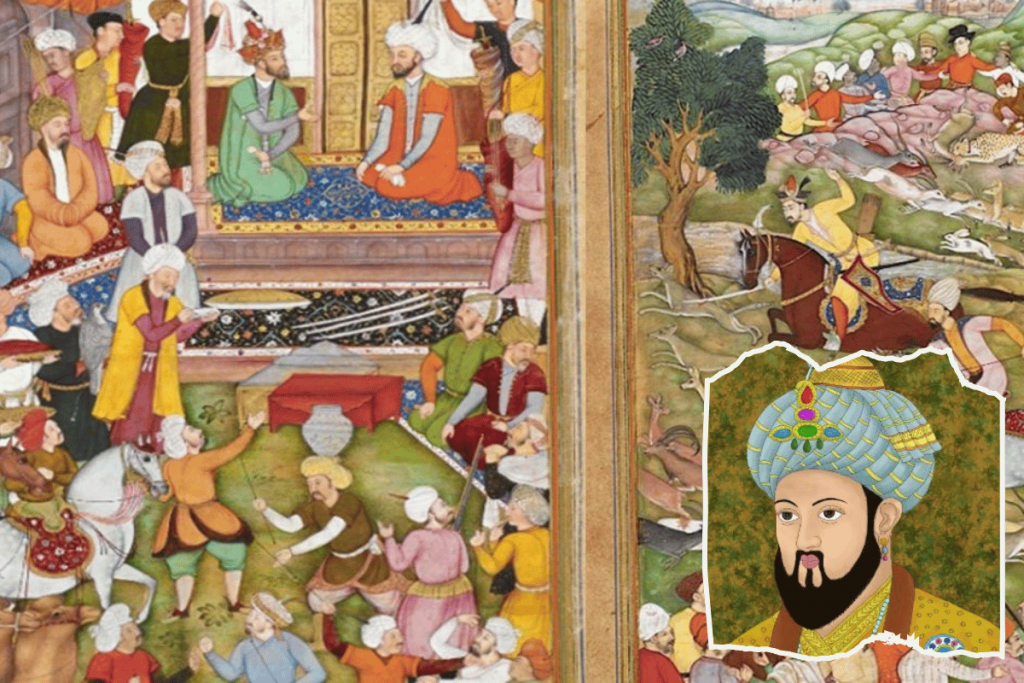
Babur, the founder of the Mughal Empire, led a life of depravity, paedophilia, violence, intolerance and indulgence. By his own accord, Babur was terrible with women. He had many wives but never loved them. However, in his memoirs, he describes in detail his love for a pre-teen boy in Ferghana – Baburi Andijani. While still married to his first wife, Aisha Sultan Begum (who was also his first cousin and was forced to marry Babur when she was only 11 years old), Babur had an affair with Baburi Andijani.
Read the full series here: Islamic invasion of India: The neglected history of colonialism
The Mughals were notorious paedophiles, and Babur was no different. Babur’s tendencies carried on through his life; he often ordered Mughal soldiers to capture young boys of the kingdoms that they had invaded, castrate them and enslave them to satisfy the sexual tendencies of the nobles. Whilst in Kabul, to add to the depravity of his early years, Babur began to drink and smoke opium regularly.
This set the stage for the birth and reign of his son Humayun. Humayun (Nasir al Din) was born in 1508 in Kabul to Maham Begum, Babur’s second wife. The fundamental urge to kill infidels/kafirs/Hindus was inherited dutifully by Humayun. Humayun carried the torch, or rather the sword, of his father’s legacy. Raised in Kabul, Humayun fought alongside Babur at Panipat (1526) and Khanwa (1527). In Babur’s memoirs, he and Humayun are said to have been astonished by the resistance of Rana Sanga of Mewar.
Rana Sanga was compared to Azrael, the Angel of Death. Now that Humayun had a taste for killing Hindus, he sought to solidify Babur’s brutal legacy. However, first, he had to navigate a period of political instability and family infighting. Humayun’s defeat at the Battle of Chausa (1539) and later at Kannauj (1540) by Sher Shah Suri led to the complete collapse of Mughal authority in North India. For the next 15 years (1540–1555), Humayun remained in exile, with the Sur Empire controlling Delhi.
The resolute defiance of Hindu kings was integral in reclaiming land that Babur and Humayun had stolen. Chief among this resistance was Raja Maldeo Rathore of Marwar (1532-1562), the lion of Jodhpur. In 1538, after being defeated by Sher Shah Suri, Humayun sought refuge at Maldeo’s court in Jodhpur. On the way to Maldeo’s court, the defeated Mughal hordes are said to have killed several cows. Maldeo, aware of Humayun’s earlier destruction and desecration of Hindu territories, refused him protection, forcing the Mughal emperor to flee further west into Sindh and eventually Persia. This moment marked a significant instance of a Hindu ruler denying legitimacy and aid to a Mughal emperor, highlighting the strength and sovereignty of Rajput resistance during a period of Mughal instability.
Preoccupied as he was with political challenges, Humayun nonetheless further embedded religious coercion within Mughal governance by adopting Shia practices in Persia and trying to impose them after his return. He made crucial alliances with Shah Tahamasp I, the Safavid ruler of Persia. To gain vital Persian military support, Shah Tahmasp required Humayun to convert from Sunni to Shia Islam, a condition Humayun reluctantly accepted. In exchange for this conversion and the promise of Kandahar, Persia provided Humayun with a substantial army, which proved crucial in his reconquest of Kabul, Kandahar, and ultimately Delhi, restoring Mughal rule in 1555.
Despite the genocide of the Hindus committed by Babur and Humayun – the rapings, killings, mass hangings, destruction of sacred sites, pillaging of villages – Babur and Humayun are immortalised in the cities of Bhārat (India). Examples in the heart of New Delhi: Humayun Road, which connects Shahjahan Road and Subramania Bharti Marg, and Babar Road, which runs from Shivaji Bridge Station to Tilak Bridge Station. Is there a Hitler Road in Tel Aviv? A Goebbels Drive in Berlin? Or perhaps a Pol Pot Street in Phnom Penh? No, there is not, but there sure is a huge Humayun Tomb in Delhi.
Unfortunately, great stories of Dharmic resistance remain in the footnotes of history. Despite Humayun’s atrocities, he has been glorified both in Bhārat and the rest of the world. Take the ‘Great Mughals’ exhibition at the Victoria and Albert Museum in London. The exhibition, which was in place until May 2025, glorifies ‘Art, Architecture and Opulence’, mainly focusing on Akbar, Jahangir and Shah Jahan (Humayun’s descendants). No references to Mughal atrocities are present at this exhibit. In focusing on Mughal art, curators Susan Stronge and Emily Hannam risk sanitising the violent legacy of the Mughals, erasing the historical suffering of the indigenous Hindu populations and presenting a one-sided narrative that prioritises aesthetic grandeur over ethical accountability. Still, for the Victoria and Albert Museum, this is not surprising – after all, this museum has a long history of glorifying colonisers and infantilising Hindus.