On Friday 14 August 2026, after sunset, the exterior façade of the Library of Birmingham was lit up green and white to mark Pakistan Independence Day. In Birmingham, the Pakistani flag was raised at a public flag-raising ceremony hosted by the Lord Mayor, held at the Consulate General of Pakistan and attended by the Consul General of Pakistan.
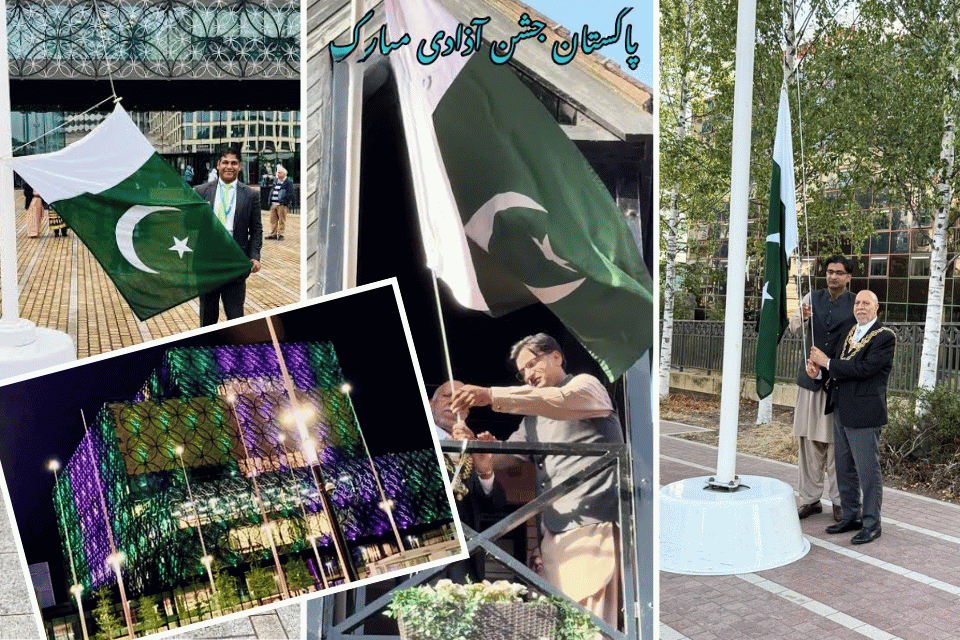
Birmingham City Council’s official website states that Pakistan emerged from the Pakistan Movement, led by the All-India Muslim League under Muhammad Ali Jinnah, which sought an independent Muslim state in north-western British India, and notes that the day is marked in Islamabad with flag-raising, the national anthem, and televised speeches, and that in the Islamic calendar the original independence date coincided with Laylat al-Qadr, a night held sacred by Muslims.
Council’s website masking the truth
After Pakistan’s independence in 1947, the Hindu population in what became West Pakistan (roughly 14.6% (about 4 million) according to the 1941 census) collapsed due to widespread communal violence, massacres (including the Rawalpindi killings of 7,000–8,000), train attacks, forced conversions, abductions, and arson. By the 1951 census, they numbered only about 531,000 (1.58%).
Pakistan means ‘land of the pure’, and it was this message of the creation of a “pure” Muslim homeland that contributed to the communal polarisation that made Partition so bloody, and why it lingers in the memory of so many Hindus.
Zaker Choudhary (the Muslim Lord Mayor of the city, who is of Pakistani descent) drew controversy recently after a video from a Pakistani Independence Day event in the city showed him saying “Our forefathers fought for our country. Kashmir is ours, Pakistan is ours, and [the] army is ours as well”.
Grooming gangs
The Pakistani Diaspora have also been in recent headlines for their overwhelming involvement in the notorious grooming gangs. Official inquiries, from the 2014 Jay Report on Rotherham to Baroness Casey’s 2025 audit, found that the majority of perpetrators who raped and trafficked mostly white British girls were men of Pakistani heritage, with the same pattern repeated across multiple towns. An independent 2026 report by MP Rupert Lowe further noted that the vast majority of those convicted were of Pakistani Muslim background.
Why, then, are Pakistani flags raised and Pakistani Independence Day officially marked with civic ceremonies in England’s second-largest city? When the Lord Mayor of Birmingham publicly declares “Kashmir is ours, Pakistan is ours, and the army is ours as well,” the question of where his primary allegiances lie becomes unavoidable. A ceremonial first citizen of a major British city is expected to embody the values and symbols of the United Kingdom; open identification with a foreign state’s army and territorial claims raises legitimate concerns about dual loyalty and the message sent to the city’s diverse communities, including its Hindu population.
Selective treatment?
At the same time, Birmingham City Council is currently seeking a High Court injunction to prohibit the unauthorised display of England (St George’s Cross) and Union flags on lampposts and other street furniture, citing public-safety grounds after the grassroots “Raise the Colours” campaign attached thousands of British and English flags across the city. The council’s action, if granted, could lead to fines or imprisonment for those who continue to fly the national flags without permission, while Pakistani flags have been formally raised under the Lord Mayor’s auspices.
Birmingham City Council has applied to the High Court for an injunction to stop the unauthorised flying of the Union Jack across the city. On 26 August 2026, it sought orders (including an interim injunction and power of arrest) against seven named people and “persons unknown” to ban flags, banners and signs from street furniture, citing some 20,000 unauthorised displays since August 2025, highway safety risks, and alleged intimidation of removal crews. Breach would be contempt of court, punishable by up to two years in prison or an unlimited fine. A hearing set for 30 September 2026 follows an adjournment; the council frames the action as purely about safety and authorisation, while critics call it a crackdown on patriotic displays.
Whilst seeking to legally ban the nation’s flag, Zaker Choudary and co fly Pakistan’s flag (a flag of division) proudly above council buildings. Where does this end? Should public resources really be used to celebrate every country’s independence day? Malta’s Independence Day happened recently; by the same logic, let’s roll out the red carpet, light up the Library of Birmingham in red and white, and hoist their flag over the Council House. Then on 30 September it’s Botswana’s turn; splendid, another £30,000 of council taxpayers’ money (exactly the sum Birmingham City Council spent on the “Spirit of Pakistan” festival) can be diverted to mark that occasion too. Once the principle is established that any foreign national day warrants official civic recognition and public funding, there is no coherent stopping point.
The only consistency on display is the willingness to prioritise Pakistan’s national symbol while treating Britain’s own flag as a public-order problem.
All eyes on the court hearing on the 30th of September then. Will the selective love for the overwhelmingly intolerant Pakistani diaspora (a homeland rooted in ethnic cleansing and a diaspora notorious for their involvement in rape gangs) trump the symbol of national unity?