When political Islam is debated in Britain, the conversation usually focuses on terrorism, extremism, or social cohesion. But the deeper issue is constitutional. What happens when a political movement that believes laws should come not from the people or parliament, but from God, operates within a democracy? Can a movement built on that idea truly coexist with a democratic system without destabilising it?
Three questions, therefore, matter. First, who gets the final say over the law: elected representatives or religious authority? Second, can laws be peacefully changed and reformed as society evolves? And third, how much control should the state have over people’s private lives, beliefs, and behaviour?
These questions matter because without them, power begins to move away from ordinary people and into the hands of those claiming religious authority. If voters and parliament no longer have the final say, then the will of a small unelected minority can be imposed on millions who never consented to it. If laws cannot be challenged or reformed, society becomes trapped under rules no generation can change. And if the state starts policing private belief and behaviour, freedom survives only within boundaries approved by authority.
Lessons from Pakistan and the contrast with Indonesia
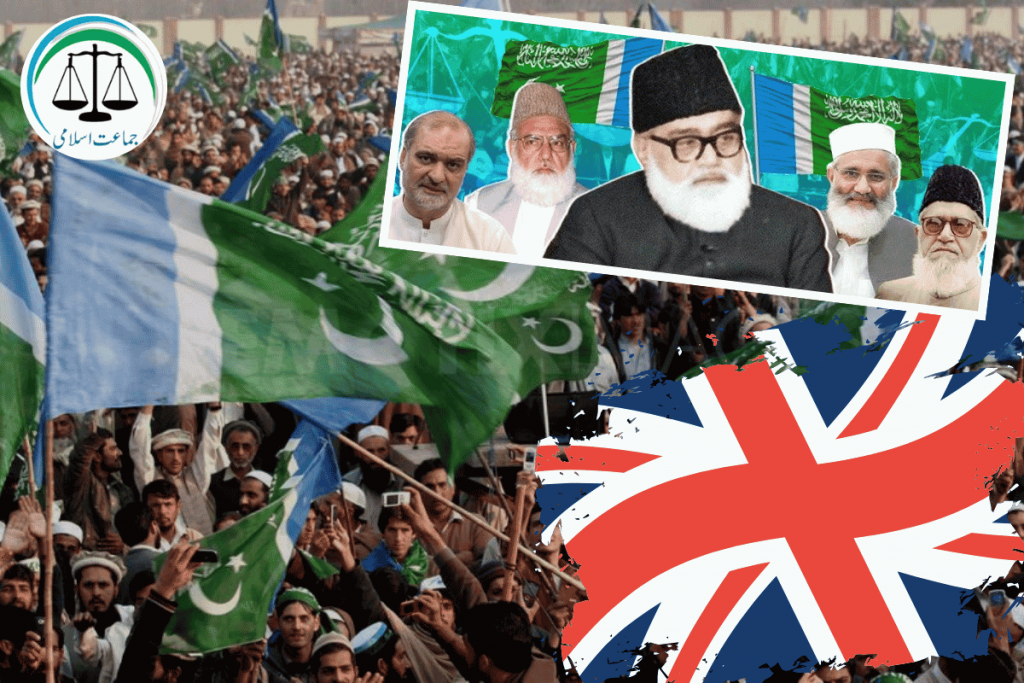
Pakistan offers a useful case study because many of these tensions have already played out there in real political and legal disputes. Yet this outcome is not inevitable in Muslim-majority societies. Indonesia, the world’s largest Muslim-majority country, remains a democracy in which governments are chosen by voters and laws can still be changed through parliament. The contrast matters because it shows that these tensions do not arise from Islam itself, but from particular political interpretations of how religion and state should interact. Nor do these ideas remain confined to Pakistan. Movements influenced by the ideology of Jamaat-e-Islami, a transnational movement committed to the Islamisation of state and law, are present, organised, and active within the United Kingdom itself.
It is 2005 in Pakistan’s North-West Frontier Province (NWFP). The Muttahida Majlis-e-Amal (MMA), a coalition of religious parties that included Jamaat-e-Islami, has just passed the Hisba Bill, granting officials the authority to monitor “un-Islamic” behaviour in public life. In practice, the bill empowered officials to police media content, regulate interactions between men and women, and enforce dress codes – echoing the powers exercised by morality police in Iran and under the Taliban.
Critics argued that provisions given to these officials were highly ambiguous, giving them greater freedom to reinterpret and enforce morality however they saw fit, and more importantly, the bill prohibited any court or alternative authority from questioning or passing orders on these officials, meaning they had no legal oversight. According to Farhatullah Barbar, Pakistan People’s Party spokesman, this bill aimed to give judicial jobs to teenage madrasa graduates. Placing unchecked moral authority in the hands of young, conservatively educated men created an obvious danger: women would be scrutinised for how they dressed, where they studied, and whether they appeared in public at all. At stake was whether individuals could remain free from religious policing in their everyday lives. Ultimately, the Supreme Court held that this bill was unconstitutional, over concerns of potential restrictions on media freedom, religious policing and women’s autonomy.
The Hudood Ordinances: Legal reform and the burden of proof
If Hisba dealt with enforcing morality, the Hudood controversy dealt with something even more fundamental: who has the authority to change the law? Introduced in 1979 as part of General Zia-ul-Haq’s wider Islamisation programme, the Hudood Ordinances restructured certain criminal offences under Islamic law. One of the most controversial changes was the rule for proving rape under the Zina (sexual morality) laws. To secure a conviction under Hudood, four adult Muslim male witnesses were required. Without such evidence, a woman reporting rape risked having her complaint treated as an admission of consensual sexual relations – itself punishable as adultery.
Critics argued that this imposed an unrealistic burden of proof and blurred the line between rape and consensual relations. Prior to the Hudood Ordinances, only men were punished for adultery. After women became directly liable under the revised Zina framework, prosecutions surged. Estimates suggest the number of women in prison rose from around 70 in 1979 to approximately 6,000 by the late 1980s. Women’s rights groups reported that victims often faced a cruel choice: report rape and risk jail, or remain silent and endure it. For poor and illiterate women, the law offered little safety and real danger.
As with the Hisba Bill, Jamaat-e-Islami mobilised against attempts to reform the Hudood Ordinances, including rejecting recommendations from the National Commission on the Status of Women. Among those leading protests was Ms Sakina Shahid, deputy head of Jamaat’s women’s wing, opposing reforms intended to protect the very women the law exposed to prosecution. This was not merely a policy disagreement. It was a confrontation over who ultimately controls the law. Once parliament loses the power to reform religious laws, democratic institutions no longer fully control the legal system. Threatening women with prosecution for reporting abuse destroys any meaningful protection of personal freedom.
Blasphemy laws and the assassination of reform
The Hudood controversy asked whether religious laws could be amended. The blasphemy controversy raised something even more serious: whether religious laws could be questioned at all without being treated as an attack on Islam. This question was answered in 2011, when Salmaan Taseer, the governor of Punjab, was assassinated for calling for reform of Pakistan’s blasphemy law. The same government that introduced helplines for women to report abuse and strengthened penalties for honour killings and acid attacks now watched their own governor’s killer, Mumtaz Qadri, showered with petals in court. As Human Rights Watch’s Patricia Gossman explains, these laws are often weaponised to blackmail rivals, settle personal scores and attack minority communities. Although the law’s punishment by death is not followed legally, a simple accusation results in lynchings by mobs who are not held accountable. More than 1400 people were falsely accused of violating the blasphemy law, most of whom are ethnic or religious minorities. Rather than prompting reform, the law’s defenders doubled down.
Munawar Hasan, head of Jamaat-e-Islami from 2009 to 2014, argued that Governor Salmaan Taseer himself was responsible for his killing, suggesting that no Muslim worth the name can tolerate blasphemy of the Prophet. Yet the only “blasphemy” in question was Taseer’s call to reform the blasphemy law. Hasan’s successor, Siraj ul-Haq (2014–2024), later urged the government to resist the international pressure to amend the law.
At that point, the issue was no longer about one law. Treating reform as religious betrayal strips parliament of the freedom to change the law. The assassination of officials advocating reform threatens democratic government itself. And when accusation alone can unleash mob violence, ordinary people can no longer live freely or safely.
The ideological roots of Jamaat-e-Islami
The pattern is not accidental. Jamaat-e-Islami was part of the MMA government that advanced the Hisba Bill, opposed amendments to the Hudood Ordinances, and resisted reform of the blasphemy laws. The explanation lies not in politics alone, but in the doctrine of this organisation. Abul A‘la Maududi, the founding ideologue of Jamaat-e-Islami, argued that “sovereignty ultimately rests with God” and that no group may claim it. He therefore rejected democracy, defined as rule by the people, stating that “Islam is not democracy”. Once ultimate authority is placed beyond the people, voters no longer truly control the laws they live under.
Maududi wrote that “none is entitled to make laws on his own authority” and that no legislator may make “even the least alteration” to divinely revealed law. Democratic reform cannot survive in a system where parliament is forbidden from changing the law.
Maududi also wrote that believers must “obey the laws set forth by Him” and that legislation exists to “safeguard” that obedience. Here, freedom means obedience, not personal choice. Forcing people to conform to fixed religious law in their speech and conduct does not protect civil liberty – it denies it.
Prominent Muslim scholars across multiple Islamic traditions warned against what they saw as Maududi’s politicisation of Islam. Traditional Deobandi scholar Muhammad Yusuf Banūrī accused Maududi of politicising Islam to the extent that acts of worship became secondary to the pursuit of state power, asking whether such a vision represented “the revival and renewal of religion, or its destruction and death.” Reformist Islamic scholar Fazlur Rahman similarly criticised Maududi’s belief that people should not have final authority over laws and government, mocking parts of the doctrine as “comic.”
From a Salafi perspective, scholars such as Abdullah al-Jarbooʿ grouped Jamaat-e-Islami alongside the Muslim Brotherhood as ideological movements focused more on political power than traditional religious teaching, while Salih al-Suhaymi later warned that the writings of Maududi contributed to the spread of “corrupt ideologies like terrorism.” Although these scholars came from different Islamic traditions, they feared that Maududi’s doctrine placed Muslims in an ongoing struggle for political dominance against non-Islamic systems of government.
Jamaat-e-Islami’s influence within the United Kingdom
The relevance to the United Kingdom lies not in importing foreign crises, but in examining whether doctrines that reject rule by the people can truly fit within a democratic system built on it. A UK government review examining networks historically associated with the Muslim Brotherhood noted that organisations originally associated with Maududi and Jamaat continue to operate in the UK, naming The UK Islamic Mission (UKIM) in specific, which runs around fifty mosques. The same review recorded that material promoted by UKIM as of July 2014 stated that “it is not possible for an observant Muslim to live under a non-Islamic system of government” and anticipated the eventual “victory” of Islam over secular democracy and capitalist materialism.
At face value, that position questions the legitimacy of Britain’s system of government. Taken to its logical conclusion, full loyalty both to this doctrine and to Britain’s democratic institutions cannot be fully reconciled. The issue is therefore not religion itself, but whether the political doctrine associated with Maududi and Jamaat-e-Islami poses risks to public order and national security.
The connection is not merely theoretical. UKIM’s 31st annual conference featured Qazi Hussain Ahmad, then leader of Jamaat-e-Islami. In interviews, Ahmad claimed to have met Osama bin Laden several times, including at Jamaat headquarters, where he said they discussed Pakistani politics and Osama’s attempts to influence it. These were Ahmad’s own claims rather than judicial findings. The point is not to make a security allegation, but to illustrate the political networks surrounding Jamaat leadership – and to underline why the ideological and organisational links between Jamaat figures and groups operating in Britain deserve serious scrutiny.
The challenge to democratic integrity
Across the Hisba Bill, the Hudood Ordinances, and resistance to reform of the blasphemy laws, Jamaat-e-Islami has consistently advanced a political doctrine that rejects rule by the people, resists legal reform, and places personal freedom under fixed religious authority. These positions are not incidental; they flow directly from the teachings of its founding ideologue, Abul A‘la Maududi. When organisations in the United Kingdom openly trace their intellectual lineage to Jamaat-e-Islami, and promote material questioning the legitimacy of non-Islamic governance, the implications for British democracy become unavoidable.
The issue is not Islam as a faith. It is whether organisations promoting the political doctrine associated with Jamaat-e-Islami and its founding ideologue Abul A‘la Maududi should face greater scrutiny when operating institutions responsible for religious education in Britain.