Navarātri, meaning “nine nights” in Sanskrit, is an important Hindu festival dedicated to the Divine Feminine, worshipped in the form of Goddess Durgā. Celebrated with prayers, rituals, music and dance (Garbā & Ḍāṇḍiyā), it is a time of devotion, reflection and spiritual renewal. Beyond its religious traditions and colourful celebrations, Navarātri carries a universal message that resonates across cultures and faiths: the journey towards overcoming our inner negativity, cultivating positive qualities and discovering the wisdom within ourselves.
In Hindu philosophy, the nine nights symbolise an inner journey of transformation, in which we work to overcome our weaknesses, nurture noble values, and deepen our understanding of life. The festival culminates in Vijayādaśamī, the celebration of victory; not merely over external obstacles, but over the limitations of our own minds. The spiritual significance of Navarātri lies in this profound journey from inner darkness to clarity, from restlessness to peace, and from ignorance to wisdom.
The theme of the entire Vedas is reflected in the Navarātri festival – the purity of mind and removal of all negativities; cultivating positive virtues; gaining spiritual knowledge and transcending limitations. This is the real victory, the dance of joy, ritualistically performed at night, to signify our spiritual awakening.
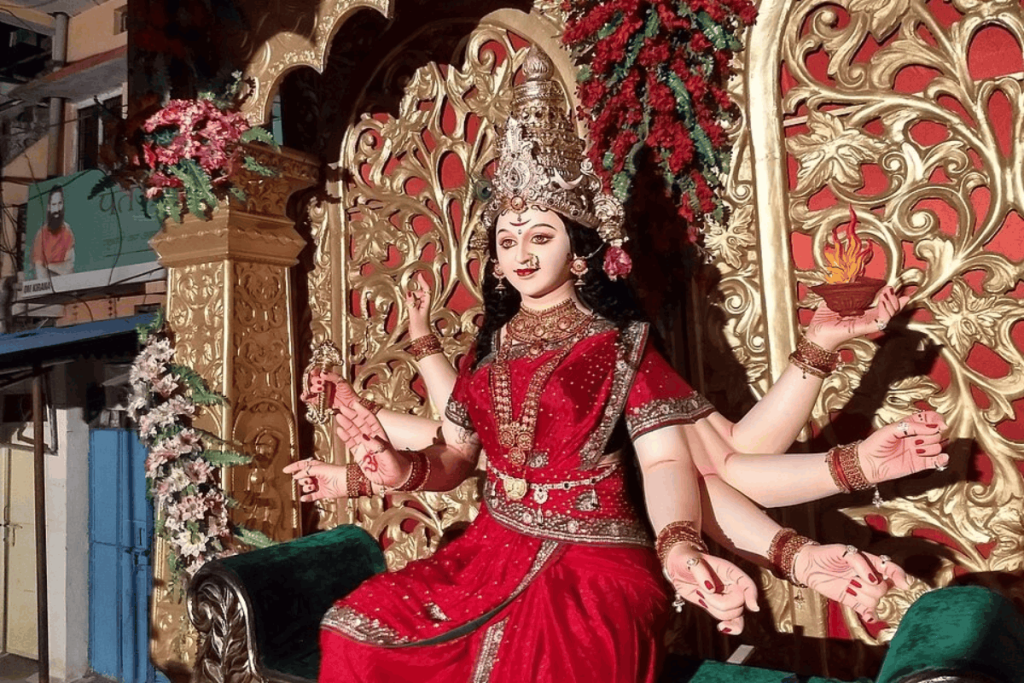
During Navarātri, the Goddess is worshipped as Durgā, Lakṣmi, and Saraswatī. Though the Goddess is one. Her three different aspects are represented and worshipped. Durgā is worshipped on the first three nights, followed by Lakṣmi on the next three days and Saraswatī on the last three days. The following day, the tenth day of the festival, is called Vijayādaśmi. Vijayā means ‘victory’, the victory over our own minds that can come when we have worshipped these three Goddesses.
Durgā – the destroyer of evil
To gain noble virtues, all evil tendencies in the mind must be destroyed. This destruction is represented by Goddess Durgā. Durgā is one who removes our evil tendencies (durgati hariṇi). This is why she is called Mahiṣāsura Mardini, the destroyer of the demon (asura) Mahiṣā. Mahiṣā means ‘buffalo’.
The buffalo stands for tamo guna, the quality of laziness, darkness, ignorance, and inertia. We do have these characteristics of tamas in us. We love to sleep, for instance, and although we may have a lot of energy and potential inside us, we prefer to do nothing, just like the buffalo that loves only to lie around in murky pools of water.
In the Paurāṇika story, where Goddess Durgā kills the Mahiṣā demon, it symbolises the destruction of the tamo guṇa within us. When we worship Durga through a fire ritual, we invoke her divine power within us to destroy our animalistic tendencies, which are otherwise very difficult to get rid of.
Lakṣmi – the Goddess of wealth
For knowledge to dawn within us, we have to prepare our minds. The mind must be pure and concentrated. This purification of the mind is attained through the worship of Goddess Lakṣmi.
There is a general belief that Lakṣmi represents only material wealth. She is the Goddess of all wealth.
Even if we have material wealth but have no self-discipline or self-control, nor the values of love, kindness, respect, and sincerity, all our material wealth will be lost or destroyed.
The real wealth is the inner wealth of spiritual values that we practice in our lives, by which our minds become purified. Only when we have these noble values will we be able to preserve our material wealth and make good use of it. Otherwise, money itself becomes a problem.
Even in “upaniṣads”, the ṛṣis (rishis; the mantra of Taittrīya Upaniṣad indicates) asked for noble values. In the absence of the right values and good qualities, all our money will be wasted.
The wealth of virtues is our true Lakṣmi. Ādi Śaṅkarācārya names six forms of wealth (ṣat sampatti) as calmness of mind ( Śamaḥ), self-control (Damaḥ), self-withdrawal (Uparamaḥ), forbearance (Titikṣā), faith (Śraddhā), and single-pointedness of the mind (Samādhānaṃ). These are to be cultivated to attain wisdom. These virtues are important because our goal is victory over the mind; a victory such that we do not get disturbed by every change that takes place in our lives. This victory comes only when the mind is prepared, and this mental purification is symbolised by the Lakṣmi Pūja.
Sarasvati – the Goddess of Knowledge
Goddess Sarasvati is the Goddess of Knowledge. Victory over mind can be gained only through knowledge, through understanding. Goddess Sarasvati represents all knowledge, including the highest Knowledge of the Self.
Thus, during Navarātri, Goddess Durgā is invoked first to remove impurities from the mind, then Goddess Lakṣmi is invoked to cultivate noble values, and finally, Goddess Sarasvati is invoked to gain the highest knowledge of the Self. When all three are gained, subjectively, then there will be Vijayādaśmī, the day of true victory!
Vijayā means ‘victory’, the victory over our own minds that can come when we have worshipped these three Goddesses.
This festival celebrates the victory of good over evil by burning the effigy of Rāvaṇa. Rāvaṇa signifies the ego. Once we have purified the mind, inculcated the positive qualities, and gained the supreme self-knowledge, ego (Ahaṅkāra) is destroyed.
“Rāvaṇa Dahan” is a ritual of burning effigies of the demon king Rāvaṇa, which signifies the burning of our extroverted desires and turning inwards to the self.
Vijayādaṣmī is celebrated in different ways in different parts of Bhārat, but worshipping feminine divinity is at the centre of the festive celebration.
Bhagwān Rāma killed the demon king Rāvaṇa and won victory on this day. Rāvaṇa had kidnapped Goddess Sitā and fled to Lankā.
During Navarātri, the rāsa dance (the dance of joy) of Shri Krishna and the gopis is also performed. As the mind becomes purer, calmer, quieter, and more cheerful, a greater understanding is gained, and we feel happier. The rāsa is the dance of joy which symbolises the joy of realisation.
The Four Navarātri Observances
According to the Hindu lunar calendar, Śarad Navarātri begins on the first day (Śukla Pratipadā) of the bright fortnight of the month of Āśvina (Ashwin), which usually falls in September or October.
The festival continues for nine nights and culminates on the tenth day with Vijayādaśamī, symbolising the triumph of good over evil.
Hindu traditions recognise four principal Navarātri observances throughout the year: Vasanta or Chaitra Navarātri in spring, Āṣāḍha Navarātri during the monsoon season, Māgha Navarātri in winter, and Śarad Navarātri in autumn. While each has its own spiritual significance, Śarad Navarātri is the most widely celebrated and is often known as Mahā Navarātri, meaning the Great Navarātri. It is particularly associated with the worship of Goddess Durgā and her victory over the demon Mahiṣāsura, which represents the triumph of righteousness over destructive forces.
Beyond this traditional narrative, the festival offers an opportunity for spiritual introspection and renewal. Its deeper significance lies in the journey of inner transformation: overcoming negative tendencies, cultivating noble virtues, and attaining spiritual wisdom. This makes Śarad Navarātri not only a celebration of the Divine Feminine but also a reminder of the potential within every individual to overcome inner challenges and discover lasting peace.
(This article was inspired by the stories from the Purānas and as narrated in various Chinmaya Mission publications and other spiritual discourses of Gurus).