Multiculturalism, at its core, relies on the basic premise of organic coexistence. It is a delicate equilibrium in which diverse cultural threads weave into a broader social tapestry without unravelling or overshadowing the host fabric. Whilst drawing an analogy from ecology, such as non-native species inadvertently altering a local habitat, may seem rather stark, it offers a relevant conceptual parallel.
When any practice expands aggressively without regard for its immediate ecosystem, it risks altering the surrounding environmental balance. True multicultural engagement requires spatial awareness, gentle restraint, and an intuitive understanding of contextual harmony.
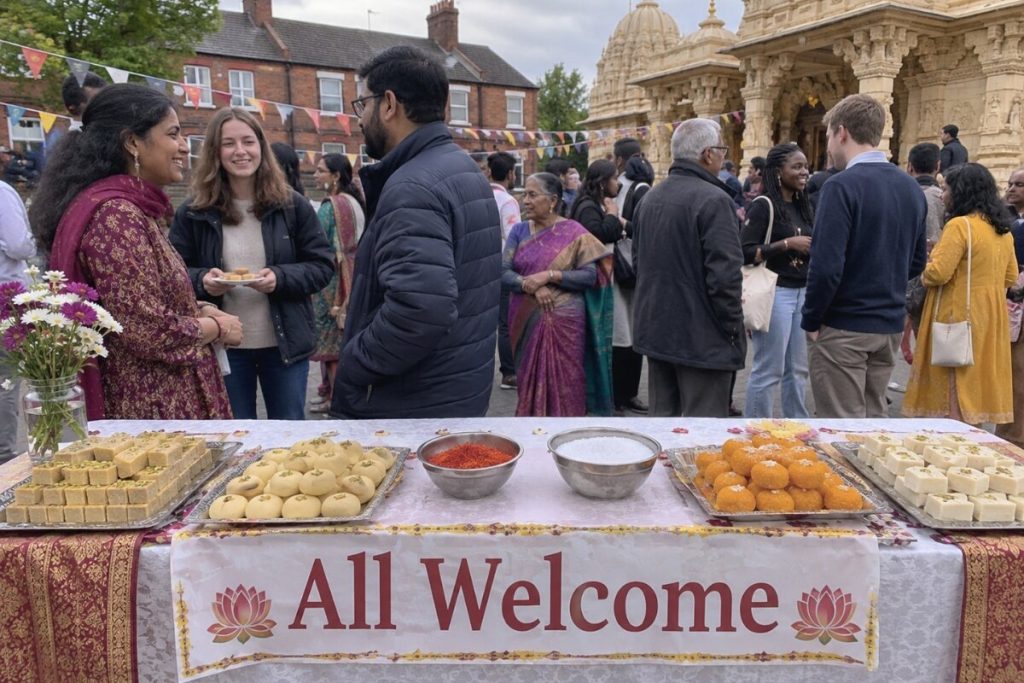
Within this framework, Sanatana Dharma and Indic culture (Sanskruti) have always exemplified peaceful coexistence over coercive assimilation. This ancient worldview has never demanded mandatory conformity from others. Instead, it warmly welcomes all into collective celebration. Common Hindu festivals such as Holi, Diwali, and Navaratri have long opened their doors to wider communities, sharing joy, light, and fellowship without imposing doctrine. The true beauty of this tradition lies precisely in its open invitation and its quiet, natural integration into shared public spaces.
However, in recent years, a subtle yet significant shift has occurred across the United Kingdom. Driven by a rapidly growing Indo-British and migrant Indian population, the scale, frequency, and public visibility of cultural and religious events have amplified dramatically. Whilst the public expression of heritage remains an entirely legitimate facet of a pluralistic society, an increasing number of these gatherings have begun to lean towards overbearing spectacle. Paradoxically, this shift raises gentle concern not only amongst the local populace but also amongst long-established Indo-British and British Hindus, who deeply understand the delicate balance required to maintain long-term social cohesion.
We see this friction emerging across various facets of civic life:
- Transplanted river rituals: Staging a grand Ganga Aarti along the banks of the Thames treats a deeply context-bound act of river veneration as an unprompted public performance for an audience unaccustomed to its Indic philosophy.
- Misplaced environmental practices: Performing large-scale Ganesha Murti Visarjan in British waterways risks transforming a sacred lesson in ecological impermanence into a point of civic and environmental concern for local residents.
- Severe penance on suburban streets: Bringing austere devotional rituals such as Anga Pradakshina out of consecrated temple courtyards, as witnessed during festivals at South London’s Lewisham temple, and onto public residential pavements presents profound inner faith as an alienating public spectacle.
- Trivialising culture in retail aisles: Organising flash-mob Garba performances inside crowded commercial spaces, such as supermarket aisles, replaces a sacred, boundary-respecting folk tradition with intrusive noise in pursuit of viral attention.
When sacred rituals and cultural celebrations are compressed into grand public spectacles or misplaced commercial stunts, they risk becoming unintended friction points within the social fabric. The diaspora and British Hindu population occupy a minor yet culturally rich place within British society. Their presence is best understood through a sweet culinary metaphor.
Consider a pinch of saffron added to an Indian dessert, whether Payasam or Laddoo. In measured, delicate quantities, saffron elevates the aroma, presentation, and flavour, enriching the entire dish for everyone. However, if one replaces those delicate saffron strands with a heavy hand, or substitutes the saffron with salt, the dish is ruined and rendered inedible for all.
This leaves a vital question upon which the diaspora ought to reflect. As we express our heritage abroad, do we intend to be the saffron that enriches the dessert, or the salt that changes its very nature? Preserving the true spirit of Dharma requires knowing not just how to practice, but where, when, and with what degree of spatial humility. True respect for our traditions lies in practising them with the dignity, sweetness, and quiet restraint by which their elegance has been defined for millennia.