“When you meet an Indian and a snake, kill the Indian first.”
The remark, attributed to former Norwegian minister of administration and UN diplomat Terje Rød-Larsen in reporting based on Epstein-related files, generated relatively little international scrutiny despite its openly dehumanising implication.


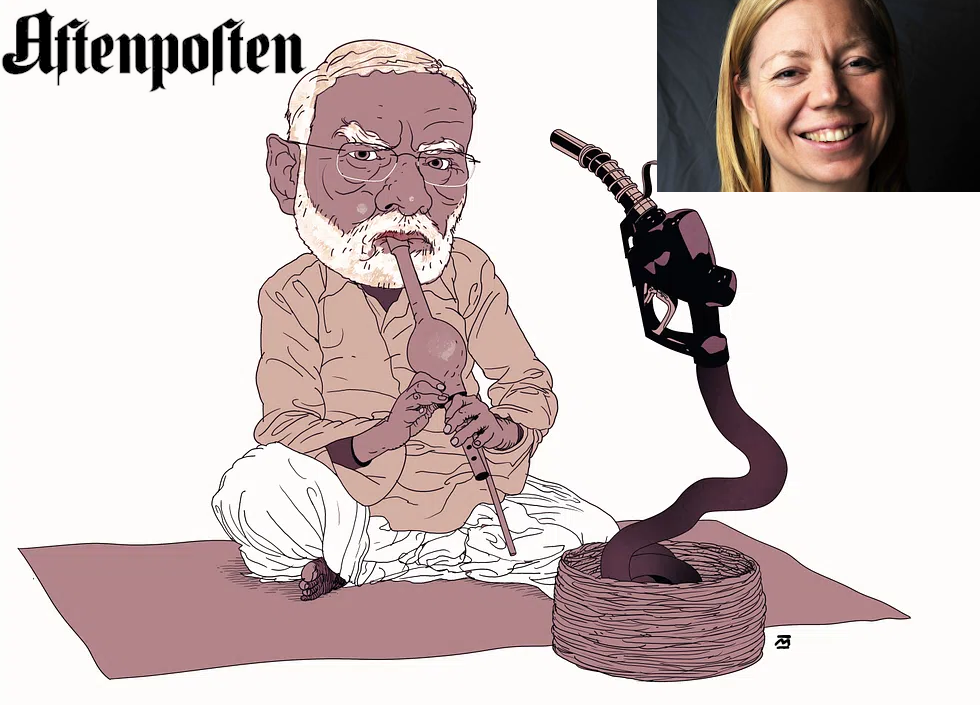
The same underlying attitude resurfaced in May 2026 when the Norwegian newspaper Aftenposten published a caricature depicting Indian Prime Minister Narendra Modi as a “snake charmer.” In response to criticism, Aftenposten CEO and editor-in-chief Trine Eilertsen defended the image as satire based on “familiar symbols” and argued that Norwegians would simply “shrug” at comparable caricatures because satire and exaggeration form part of Norway’s culture of expression.
However, European societies, including Norway, recognise that stereotypes and caricatures can reinforce historical prejudice when directed towards communities such as the Sámi, Kven, and Forest Finn peoples. European institutions increasingly apply high levels of moral and interpretive sensitivity toward groups situated within Europe’s internal historical framework.
Yet when racialised imagery inherited from the foreign occupation of India is directed toward Indians, many of those same institutions suddenly insist such portrayals are harmless satire.
The “snake charmer” caricature did not emerge in isolation. It belongs to a long tradition of imagery constructed during Europe’s violent past, where non-Europeans were represented as subhuman. Often worthy of extermination. Over generations, these caricatures became normalised within European consciousness and eventually perceived as culturally neutral.
This does not place India beyond criticism. India possesses serious internal problems, which Indians themselves debate continuously and intensely. India is a large democracy of more than 1.4 billion people operating within levels of linguistic, religious, ethnic, and political diversity unmatched in Europe.
However, reducing one of the world’s oldest continuous civilisations with cultural and historical roots stretching back roughly 5,000 years to snakes and “snake charmers” reflects not clever satire, but the persistence of racialised imagery inherited from the history of European violent conquests.
Dehumanisation as a political tool continues: from the bloodthirsty Viking raiders to the horrors of the Portuguese Inquisition, from the severed hands of Belgian brutality in the Congo to the Malthusian mass starvation imposed under British conquest in India, and ultimately to the genocidal racial hierarchies of the Nazis.
The controversy surrounding Aftenposten reveals less about India than about Europe itself: a persistent inability within parts of the European media to recognise that occupation-era assumptions and inherited racial hierarchies still shape how non-Western societies are portrayed, judged, and diminished.
Germany, for example, maintains strict legal and cultural prohibitions surrounding Nazi-era racial imagery, anti-Semitic caricatures, and forms of propaganda associated with historical persecution. Contemporary German society does not dismiss such representations as harmless satire simply because they were once familiar symbols within European culture. Historical normalisation is understood precisely as part of the danger.
Norway itself applies similar reasoning internally. In 2019, the Oslo District Court convicted a man for making degrading and offensive statements directed at Sámi people, recognising that language and public expression can reinforce historical prejudice.
Neither Norway treats all historical stereotypes as harmless satire, nor does Europe uniformly shrug at racialised caricature. That is the real Norwegian hypocrisy. That is Aftenposten’s double standard.
In an age where journalism increasingly sacrifices substance for clickable provocation, racial stereotypes survive not because they are true, but because too many institutions still confuse inherited prejudice with cultural sophistication. If the only “familiar symbols” editors can reach for are caricatures inherited from Europe’s violent past, then the crisis facing modern journalism is not declining trust, but declining seriousness.
Perhaps less time should be spent by Helle Lyng, Trine Eilertsen, Frank Rossavik, and Marvin Halleraker self-congratulating one another for inhabiting the “world’s freest press,” and more time asking why parts of Norwegian journalism still appear intellectually dependent on the same racial caricatures once circulated across Europe during its violent past.
References
- https://jmail.world/thread/EFTA01744032?view=inbox
- https://www.aftenposten.no/meninger/kommentar/i/rrzeVa/modi-vil-vaere-venn-med-alle
- https://www.theguardian.com/world/2024/nov/12/norway-apologises-to-sami-forest-finns-and-kvens-for-forced-assimilation-policy
- https://www.scup.com/doi/full/10.18261/issn.2387-3299-2021-02-02