Ever sent a donation to a temple, a non-governmental organisation (NGO) project, a school, or a disaster relief fund in India? India’s Foreign Contribution (Regulation) Act (FCRA) exists to make sure that money actually reaches the people and institutions it was meant for safely, legally, and transparently.
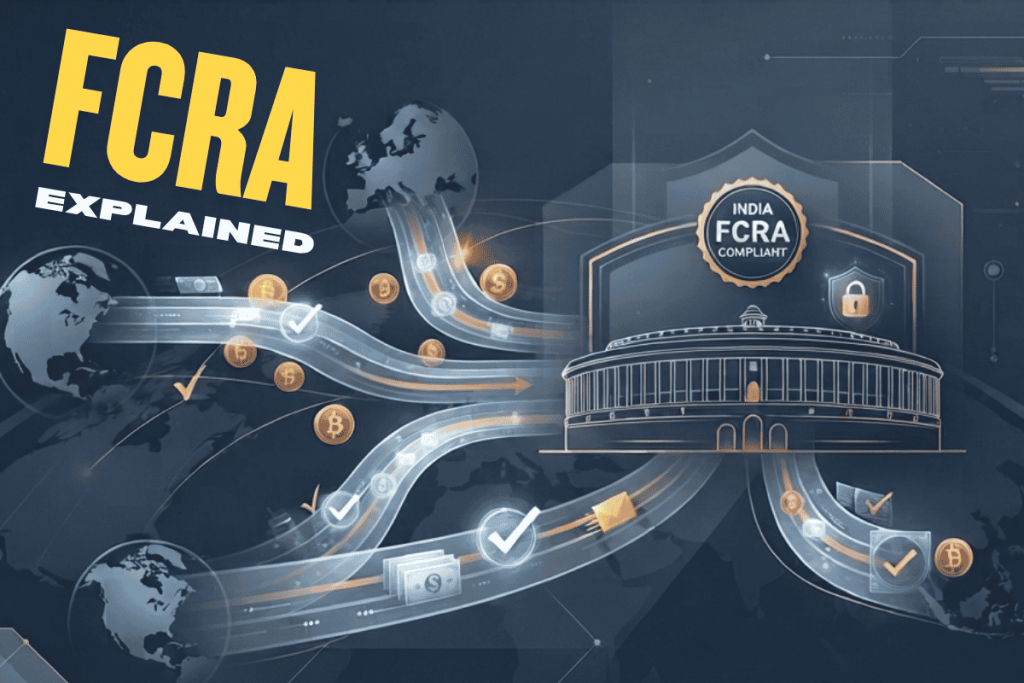
In June 2026, India tightened this framework further with the FCRA (Amendment) Rules, 2026, which came into force on 22 June. A further FCRA (Amendment) Bill, 2026 is currently before Parliament, expected to strengthen the law’s enforcement architecture once passed. Together, they mark the most significant update to India’s foreign funding rules since 2020.
For the British Hindu & Indian diaspora – a community that gives generously to temples and charitable causes in India – understanding what this law does, why it exists, and the subversion it actively guards against matters.
What is the FCRA?
- The Goal: Regulate the flow of foreign money into Indian non-profits, associations, and individuals to prevent unauthorised foreign influence over domestic civic life.
- The Rule: Every organisation receiving foreign funds must register with the Ministry of Home Affairs and route contributions through a single, designated bank account at the State Bank of India, New Delhi Main Branch, ensuring every rupee is traceable.
- The 2026 Update: The new Rules enforce purpose-specific and state-specific registrations, explicitly prohibit proselytisation, introduce strict accountability for “key functionaries,” and create a framework where a government-appointed “Designated Authority” manages assets of entities that lose registration.
- Bottom Line: FCRA does not stop foreign giving; it ensures that giving is honest, legal, and reaches genuine causes rather than being diverted, laundered, or used to fund activity the receiving country never signed up for.
A national security and national interest framework
FCRA sits within a long Indian legal tradition dating back to 1976, built on a fundamental principle: a sovereign democracy has the absolute right to know who is funding influence over its public life, its politics, its religious institutions, and its civil society.
The 2026 statutory updates were introduced against a backdrop where foreign funds have repeatedly been traced to organisations engaged in activity detrimental to national security, state stability, and social harmony.
1. When “charity” masks subversion: Convictions and banned entities
The Indian government’s drive to tighten compliance is not based on theoretical risks. Indian courts and judicial tribunals have repeatedly substantiated instances where foreign funding networks were deployed as weapons against state sovereignty:
- Direct Secessionist Terror Funding (Yasin Malik Case): In May 2022, a Special NIA Court convicted terrorist leader Yasin Malik, sentencing him to life imprisonment. Investigators proved that foreign funds were funnelled into Jammu & Kashmir from Pakistan-based terror handlers (including Lashkar-e-Taiba’s Hafiz Saeed), Pakistani diplomatic channels, and overseas hawala networks. These overseas funds directly financed violent street protests, stone-pelting, and armed secessionism.
- Diplomatic Espionage (Madhuri Gupta Case): In May 2018, a Delhi court convicted Indian diplomat Madhuri Gupta under the Official Secrets Act. Compensated by handlers from Pakistan’s ISI, she compromised national security by leaking classified military intelligence and names of Indian officers operating abroad to a hostile foreign intelligence service.
- Radicalisation Fronts Disguised as Charities (IRF & RIF):
- Islamic Research Foundation (IRF): Founded by Zakir Naik, the IRF was declared an “Unlawful Association” under the Unlawful Activities (Prevention) Act (UAPA), a ban upheld by a High Court Judicial Tribunal in March 2022. The Enforcement Directorate (ED) proved that over ₹193 crore in suspicious foreign funds were routed through UK-registered trusts (IRFI) and Middle Eastern media conduits (Global Broadcasting Corp) to broadcast radical speeches, promote communal hatred, and fund offshore networks like Peace TV.
- Rehab India Foundation (RIF): Operative as the charitable wing of the banned Popular Front of India (PFI), RIF had its UAPA ban affirmed by a High Court Judicial Tribunal in March 2023. Investigating agencies (NIA and ED) tracked cross-border hawala channels, non-resident bank account pooling (NRE/NRO), and fictitious Gulf donors. Under the cover of social welfare, these funds were diverted to finance radicalisation camps, procurement of weapons, and targeted assassinations.
2. Weaponised protests & foreign amplification: The 2020 – 21 farmers’ agitation
Beyond direct violence or radicalisation, federal agencies have highlighted how legitimate economic grievances can be leveraged and sustained by external actors targeting Indian political stability. The 2020 – 21 Farmers’ Protests served as a turning point in how regulators view indirect foreign funding and digital mobilisation:
- Open Declarations of Regime Change: Hungarian-American billionaire financier George Soros and his Open Society Foundations (OSF) have repeatedly taken public stances against India’s political leadership. Having declared nationalist governments a major threat at Davos in 2020, Soros publicly asserted in February 2023 his intent to see a “democratic revival” in India aimed at weakening the current government. Indian Union ministers and ruling officials directly accused Soros and affiliated networks of sponsoring global campaigns to destabilise Indian democracy.
- Sustaining Domestic Agitations via Overseas Conduits: Federal agencies (including the ED and NIA) tracked financial flows and digital toolkits designed to prolong the 2020–21 protest camps on Delhi’s borders. The investigation into the global “Farmers’ Protest Toolkit” traced its origin to the Canada-based Poetic Justice Foundation (PJF) – an entity flagged by Indian intelligence as a pro-Khalistani front organisation. Overseas funding passed through non-profit fronts in North America and Europe to finance PR campaigns, logistics, and international digital strikes.
- The OSF Watchlist Precedent: OSF had already been placed on the MHA’s “Prior Permission” watchlist in 2016 due to unapproved domestic grants and FCRA non-compliance. While direct bank transfers from OSF to protest leadership were legally blocked by MHA oversight, investigators focused on secondary and tertiary routing – where funds are channelled through global human rights coalitions, independent media syndicates (e.g., OCCRP), and environmental networks that OSF routinely funds globally.
3. The grey zones: Institutional misrepresentation & environmental fronts
A prominent case highlighting regulatory enforcement involves the Students’ Educational and Cultural Movement of Ladakh (SECMOL), founded by climate activist Sonam Wangchuk. In September 2025, the MHA cancelled SECMOL’s FCRA license following financial inquiries by the Central Bureau of Investigation (CBI) into SECMOL and its sister institute, the Himalayan Institute of Alternatives Ladakh (HIAL).
The MHA flagged procedural violations, such as cash deposits into FCRA accounts – and raised alarms over foreign funding, including a grant of ₹4.93 lakh from Swedish NGO Framtidsjorden (Future Earth). The government highlighted project documentation touching upon “sovereignty” in a geopolitically sensitive border region as contrary to national interest. While Wangchuk defended the project as focusing strictly on “food sovereignty” (agricultural self-reliance) and noted HIAL’s foreign inflows were consultancy fees for cold-desert engineering (Ice Stupas), the case underscored the state’s zero-tolerance stance toward foreign money influencing border region dynamics.
Investigative links within European civil society further demonstrate how these networks overlap: Framtidsjorden operates within the exact same Swedish environmental ecosystem that actively collaborates with global figures like Greta Thunberg (participating in joint initiatives like purchasing and distributing climate literature to the Swedish Parliament). For Indian intelligence agencies, these ideological and financial linkages illustrate how easily foreign agendas can penetrate sensitive domestic narratives under the cover of environmentalism or youth advocacy.
India isn’t alone: This is a global trend
One of the strongest justifications for FCRA enforcement is that India is taking steps consistent with major Western democracies. Open societies globally are recognising that unregulated foreign money poses a direct threat to domestic sovereignty:
- United Kingdom: The Foreign Influence Registration Scheme (FIRS), established under the National Security Act 2023, came into force in July 2025. It mandates that anyone acting on behalf of a foreign power or carrying out foreign influence activities must register with the Home Office or face criminal prosecution.
- United States: The Foreign Agents Registration Act (FARA), active since 1938, saw an aggressive enforcement push through 2025 and 2026, with federal agencies targeting covert foreign funding in academic institutions and non-profits.
- Canada: The Foreign Influence Transparency and Accountability Act (2024) explicitly cites a global consensus among allies that foreign influence registries are vital to counter covert foreign interference.
- European Union: The EU’s ongoing foreign interference framework reflects wide public demand across Europe for strict visibility into foreign-funded lobbying and NGO activities.
FCRA is not an anomaly; it is India’s version of a global national security imperative.
Impact on the Indian diaspora and British Hindus
While critics attempt to portray FCRA tightening as a blow to international philanthropy, the practical impact on ordinary diaspora givers, including British Hindus, remains mild and largely protective:
- Rerouting Protection: For the diaspora, the primary concern is ensuring that hard-earned money sent for temple welfare, schools, or social relief is not rerouted toward covert anti-national agendas.
- Direct Traceability: Mandatory SBI New Delhi account routing removes shady middlemen, providing clear sight of funds from a bank transfer in London or Birmingham directly to verified project accounts in India.
- Protecting Genuine Institutions: Stricter rules protect authentic Hindu charitable trusts from being tarred by the same brush as malicious actors who use non-profit status as a front for subversion.
Key case synthesis: Foreign inflows vs. state intervention
| Organisation / Entity | Stated Cover / Activity | Documented Illegal / Subversive Action | Overseas Source / Mechanism | Legal & Judicial Status |
| Yasin Malik / JKLF | Political Self-Determination | Terror financing, stone-pelting, waging war against India | Pakistan-based terror outfits (LeT), ISI, Hawala routes | Convicted; Life Imprisonment (Special NIA Court, 2022) |
| Madhuri Gupta | Diplomatic Operations | Espionage, leaking classified defence & intelligence data | Pakistani ISI handlers (Cash & Hospitality) | Convicted; 3 Years Imprisonment (Official Secrets Act, 2018) |
| Islamic Research Foundation (IRF) | Religious Education & Charity | Disseminating hate speech, promoting radicalisation, illegally laundering media funds | IRFI (UK), Global Broadcasting Corp (Dubai), Middle East donors | Banned under UAPA; Upheld by High Court Tribunal (2022) |
| Rehab India Foundation (RIF) | Social Welfare & Poverty Relief | Financing PFI extremist camps, arms procurement, targeted killings | Gulf hawala networks, NRE/NRO account pooling, fake trade invoices | Banned under UAPA; Upheld by High Court Tribunal (2023) |
| SECMOL / HIAL | Educational & Environmental Reform | FCRA procedural breaches; foreign funding touching on sensitive border sovereignty issues | Framtidsjorden (Sweden), Swiss/Italian entities, commercial remittances | FCRA Registration Cancelled; CBI Inquiry Initiated (2025) |
| 2020–21 Farmers’ Protest Conduits | Agrarian Rights Advocacy | Financing prolonged border blockades, PR toolkits, international digital warfare | Poetic Justice Foundation (Canada), OSF-backed secondary networks, Khalistani fronts | Toolkit Inquiries Initiated; FCRA Rules Tightened (2021–2026) |
Conclusive pointers and evolving horizons
- From Direct Grants to Hybrid Warfare: As FCRA regulations successfully plugged direct foreign remittances into domestic non-profits, foreign funding mechanisms evolved. The battleground has shifted toward hybrid channels, using international PR agencies, offshore media syndicates, and global digital “toolkits” to project political pressure back into India.
- The Interconnectedness of Global Foundations: The overlap between Western foundations, climate advocacy networks, and domestic political agitations highlights an ecosystem where philanthropic capital frequently blends into ideological interventions.
- Regulatory Agility: The statutory updates introduced in the 2026 FCRA Amendment Rules and Bill demonstrate that state surveillance over foreign capital is no longer limited to tracking simple bank transfers; it now encompasses secondary routing, offshore shell entities, and key functionary liabilities.
Editor’s Note: This exposition forms part of an ongoing journalistic investigation into cross-border financial trails, political philanthropy, and sovereign regulatory countermeasures. As investigative agencies continue to unearth financial logs, corporate filings, and secondary money trails across European and North American capitals, further expositions will follow.
References
FCRA (Amendment) Rules, 2026 and Bill, 2026
- Ministry of Home Affairs, Government of India: FCRA Online portal (registration data, rules, notifications): fcraonline.gov.in
- Press Information Bureau, Government of India: FCRA Framework Factsheet: pib.gov.in
UK’s Foreign Influence Registration Scheme (FIRS)
- UK Government / Home Office: FIRS guidance: educationhub.blog.gov.uk
- Covington & Burling: “UK Foreign Influence Registration Scheme Launches”: cov.com
Global comparators (US, Canada, EU)
- U.S. Department of Justice: Foreign Agents Registration Act (FARA) enforcement unit (background on the 1938 law and 2025 enforcement posture)
- Government of Canada: Foreign Influence Transparency and Accountability Act, 2024
- European Commission: Proposed EU transparency framework on foreign interference