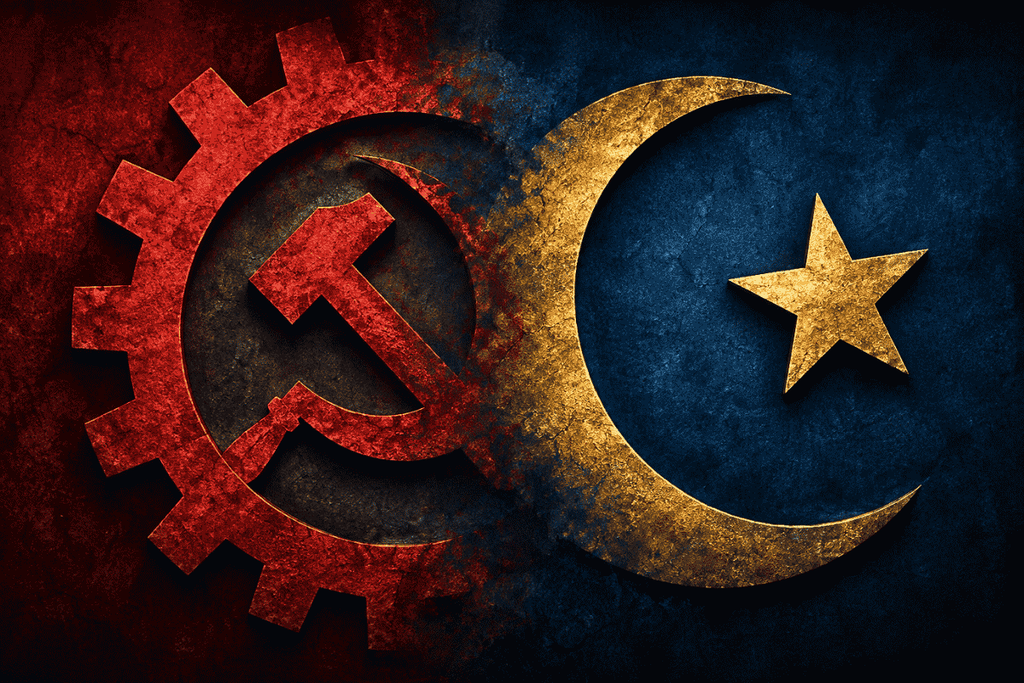
The strange and often overlooked convergence of political Islamism and communism reveals how two seemingly contradictory ideologies – one an atheist, materialist framework born of the industrial age, and the other a dogmatic, faith-based system rooted in absolute obedience have historically aligned to advance shared political goals and reshape global power structures.
A new idea after the Industrial Revolution
Communism came about in the late 1800s as a way to try out new social ideas in Western societies that were starting to boom with industry. This was a few centuries after Europe’s Cultural Renaissance, which followed nearly a thousand years of tougher times known as the Dark Ages. The continent had to learn to deal with newly wealthy business owners, bankers, and merchants, along with the old royalty, who were getting rich from resources taken from places like Central and South America, sub-Saharan Africa, India, and Southeast Asia. They set up factories making everything from clothes to metal goods to meet demand from customers in the newly colonised Americas and a changing Indian society under British influence.
A new group of working people left their family farms and traditional jobs serving the nobility to work in these factories. They drove production, but often at the cost of long hours, poor conditions, their health, and family life; sometimes even their kids worked for low pay. England and Germany were on track to be early testing grounds for communism, but Russia got there first, due in part to mistakes during World War I and the ongoing system of serfdom under the Tsar. It became the first country to fully adopt communism. The idea then spread to Asia (helped along by British colonials who wanted to steer emerging independence movements toward Marxist ideas instead), Europe, Latin America, and later Africa.
How it differed from the German National Socialists
The Nazi movement had socialist roots but was tied to Christian traditions. Both shifted people’s focus away from positive changes in society, economy, and education, and instead turned anger toward certain groups, like Jews, Roma (Gypsies), and Slavs Landowners, nobles, and royals often faced heavy consequences for their wealth under Bolshevik groups. This was different from the German National Socialists because communists saw religion as something that held back social progress and equality. Still, that didn’t stop their own deep-rooted antisemitism, which showed up in pogroms carried out with the same intensity as in the old Tsarist days.
The spread from Arabia and parallels with Christianity
To understand how these two systems eventually converged, one must look at the second pillar of this alliance. Political Islamism started about 1,200 years before communism. Like communism, it involved overturning long-standing civilisations and destroying icons across Eurasia, stretching from the Indus Valley in the east to the Iberian Peninsula in the west. Its core tenet was total obedience to one God and his final messenger, leaving no room for other belief systems if followers wanted to experience paradise in the afterlife. Breaking these rules resulted in harsh punishment, exile, or even death. This strict conditionality created groups of devoted, obedient followers who overthrew old kingdoms and societies, seeking rewards from leaders in this life and heavenly rewards in the next. While its expansion mirrored the spread of Christianity five centuries earlier, its fiercest battles took place inside palaces and centres of power, driven by demands for absolute loyalty to a single God, with promises of a perfect afterlife.
The opium of the masses
Marx called religion the “opium of the people,” and communism aimed to push back against that. But communism had its own key figures, like Marx and Engels, whose ideas on society and the future clashed with religious views. There was a feeling that many of Europe’s wars came from intense religious passion, like the Spanish Reconquista, the Crusades, and Ottoman invasions. Over time, though, communism started to echo some Abrahamic religious traits (from Judaism, Christianity, and Islam) by requiring full loyalty to its ideas. Critics were quieted or sent to labour camps or gulags, much like heretics in the Middle Ages. Potential challengers to communist leaders were pushed out of the intellectual and political scenes with similar determination. Suppressing organised religion became a priority, as happened in Russia, Central Asia, and parts of Eastern and Central Europe. There, Christianity (and Islam in places like Albania, Bosnia, and Central Asia) was sidelined, and religious groups lost their large properties to state control.
Dogma masked as reason
Communist and Marxist groups often positioned themselves as champions of reason against the rigid teachings of established religions. But this focus on logic faded amid power struggles in the Marxist governments that formed in the mid- and late-20th century. At first, the divide seemed wide between strict religious societies based on Abraham’s teachings and the new communist systems promising a society without classes, built on shared communities. That gap stayed until the Cold War kicked off in the 1940s and ran into the 1960s.
The church was seen as a tool of colonialism and was set aside to make room for communist ideas in Spanish-speaking parts of the Americas and former French and Portuguese colonies in sub-Saharan Africa. Islamic leaders faced similar scrutiny, criticism, and tight controls in Central Asian republics, and that continues today in China’s western province of Xinjiang (also known as Kashgar or East Turkestan).
Oil discoveries in West Asia
The Arab-Israeli conflicts, starting from the post-Holocaust return of Jews to their ancestral land, led to the creation of another religion-based state in the 1940s (besides Islamic Pakistan carved from India). The rivalry for influence, resources, and territory in Latin America and Africa between the West and Moscow turned former allies, like the US, Britain, and France, against Russia. The finding of oil and its growing use in transport and industry made this ideological clash even more intense. Interestingly, the same regions that gave rise to religious ideas were now caught up in similar divides for not-so-different reasons.
Gains from colonial wealth
After the war, Europe embraced ideas of freeing industrial workers, while also moving away from church influence (more so in Protestant areas than in Catholic areas). This opened up space in society, administration, and education for groups inspired by communism, who benefited from shifts in living standards, public health, and more people going to university, changes that built on work from about a century earlier. Wealth from former colonies, plus government reforms, allowed for advances in transport, infrastructure, communications, and social improvements through post-industrial tech. Many liberal ideas were linked to leftist efforts, and the rise of student, worker, and non-government groups had both social and political impacts.
Shifting labels and class struggles
Movements for independence or autonomy, like in Northern Ireland, Catalonia, and the Basque region, drew from Marxist thinking. This framed rulers as oppressors in a class struggle, and any methods were seen as fair to achieve full independence. This way of labelling the dominant ethnic or religious group as the oppressor was also used against mostly European leaders in Central and South America, where there was a historical basis for it. But it was applied similarly in the Arab-Israeli conflict and as an extension of the Aryan Invasion Theory (promoted by the British to support Anglican conversions) in India.
Occupiers, outsiders and Aryans
Even though most Jewish refugees in Israel came from Arab and West/Central Asian countries, a common story painted them as European occupiers of Palestinian territories under British mandate. The European part was actually a minority, and many had fled multiple times, from reconquered Spain and then Ottoman lands. Similar misleading labels were used against Hindus by Christian missions in colonial southern and northeastern India. The Dravidian movement grew from such ideas, leading to harm against Hindus and damage to their sacred sites.
How the British weakened revolutionaries
Challenges from revolutionary parts of India’s independence movement led to assassinations in Britain and India in response to harsh colonial rules, plagues, and famines enabled by the British government. The colonial response included not just prisons for political figures but also introducing communist ideas and structures into these groups, both mentally and through direct involvement. Soldiers returning from World War I battlefields played a small role in spreading it. Sharing Karl Marx’s works among revolutionary prisoners helped shift anger from colonisers to landlords and the middle class (both largely created by British rule, with many new wealthy people benefiting directly from it). Islamic groups in the Indian subcontinent joined these communist circles as part of efforts to justify creating a Muslim homeland.
Taking resources and taxing the masses, whilst preaching
Communist ideas of autonomy based on ethnicity and language (as outlined in India by Adhikari in 1942) were oddly not allowed in Russian or Chinese leadership but were encouraged in British and independent India, as well as Europe. This found backing from and for the Muslim League in their push for Pakistan. After the First War of Indian Independence (called the Sepoy Mutiny by colonisers), the British worked more closely with former Muslim rulers and nobles in the northern plains, who wanted to reclaim pre-Maratha Mughal areas after the Europeans left. This included influencing the Sikhs’ holiest site, the Akal Takht, and their thinkers, along with Islamic alliances, leading to the Martial Races theory. The British played both sides: enforcing taxes through local rulers while stirring class and ethnic tensions to distract from widespread poverty caused by poor food policies that supported the Industrial Revolution and troops in India and beyond.
Islamic separatism and breaking up regions
As communists grew from former revolutionaries, they were influenced by Muslim League members to build public support for Islamic homelands. This idea spread to the church-inspired Justice Party, which sought a separate Dravida Nadu, and continued after 1947 (into the 1970s) by turning Northeast India into a group of Christian states. The League quietly supported balkanising India into smaller ethno-religious states, planning to absorb them into Pakistan’s western and eastern parts later. This was mentioned by Mujib ur Rehman in the early 1970s after Bangladesh replaced East Pakistan. His plan involved demographic shifts to take over Northeast India for East Bengali Muslims, similar to the Nazi Lebensraum idea for Europe.
Changes in population and terrorism
This demographic alteration strategy was not unique to the Nazis or Bangladesh’s Jamaat-e-Islami; it was also used to push for “autonomy” in Kashmir under Articles 370 and 35A, which were rescinded in 2019. Indian communists have supported these projects of religious and ethnic separation since the 1960s, even backing China’s invasion of India in 1962. This military setback encouraged Pakistan to launch a follow-up attack in 1965. Today, communists are active in separatist movements in Manipur, a Northeast Indian state with a significant Hindu Meitei population. Supply lines for these movements run from Islamist militias in Bangladesh (monitored by Pakistan’s ISI) and across Nepal’s porous borders, where Indian and Nepali communists share common ground with ISI-funded groups. This network is heavily supported by arms and funds from communist China, which grew even stronger after a pro-Chinese government took power in Nepal following a violent palace coup in 2001.
Plans to divide
Cooperation between Islamist and Marxist groups went beyond funding and arming insurgents in Northeast India. A corridor of Maoist activity stretched from the Nepal border down to southern Karnataka, supporting not just Marxist-Maoist groups in states like Bihar, West Bengal, Odisha, Chhattisgarh, Telangana, Andhra, and southern Karnataka, but also Islamic cells that evolved into outfits like the Students Islamic Movement of India (SIMI), Indian Mujahideen, and more recently the Popular Front of India (PFI). These groups were behind various attacks in India, from riots in the 1990s to bomb blasts in 2007 up to 2013. The 2009 Mumbai attacks killed nearly 200 people, with one attacker captured (Kasab), and leftist lawyers and Marxist NGOs pushed for his pardon through the courts. Similar efforts at the presidential level were made for those behind the 2001 Parliament attack and the 1993 Mumbai blasts.
Leftists in West Asia
This domestic cooperation in India mirrored a global, historical pattern of alliance. Connections between Western radical leftists and Palestinian militant groups date back to the late 1960s and 1970s. For example, the West German radical group Baader-Meinhof (Red Army Faction) actively supported and participated in operations alongside the Popular Front for the Liberation of Palestine (PFLP), a Marxist group led by George Habash. In June 1976, two members of this West German faction joined PFLP terrorists in hijacking an Air France flight from Tel Aviv to Paris, routing it via Athens and Libya to Entebbe, Uganda. Four years earlier, in May 1972, the PFLP also collaborated with the Japanese Red Army to carry out the Lod Airport attack. Throughout this period, the Marxist PFLP frequently coordinated its activities with Islamic groups, such as Yasser Arafat’s Fatah and the PLO.
Woke activists, mainstream media, and anti-Hindu sentiment
Similar to the rise of Islamist-linked antisemitism in Europe, there’s been a steady increase in anti-Hindu feelings, or Hindumisia. Attacks on Hindu properties and temples happen, but leftist media (like the Guardian, Observer, Independent, and BBC) often downplay the role of Islamist groups in starting them. Political leaders and council members sometimes blame Hindus or Hindutva for the issues, as seen in the Leicester and Birmingham incidents from August to September 2022.
Painting the victim as the aggressor – Anti-CAA protests
This alliance of political and media leftists with Islamists in places like Britain, Germany, the Netherlands, the U.S., Canada, and Australia has led to Islamic groups organising violence against Hindus, sometimes through proxies like Punjab separatists, followed by articles blaming the Hindus. This occurred not just in the 1990s in London and the Midlands but also after India’s 2020 law on illegal immigrants from neighbouring countries. The anti-Citizenship Amendment Act (CAA) protests turned into attacks on Hindus in parts of India, especially Delhi, and then the media twisted it to blame the Hindus as the ones causing trouble. This was in outlets like the Washington Post, New York Times, Time, and The Economist, where left-leaning journalists sparked significant criticism for what many viewed as a one-sided narrative about crimes by Islamist mobs with local political backing.
The pandemic exposed anti-Hindu bias
Even during the COVID-19 pandemic, there was organised criticism of India and Hindus, with images of funeral pyres used globally (copyrighted by international media) during the second wave, often with input from apologist journalists like Danish Siddiqui in 2021. The backlash India faced was part of a broader push for things like pharmaceutical interests and even regime changes, as seen in the U.S. with Trump and Brazil with Bolsonaro. Later, some media outlets acknowledged India’s healthcare efforts after comments from the WHO chief and its vaccine sharing with over 90 countries, mostly in the Global South, areas where Western countries didn’t provide much help. Once the pandemic eased, the one-sided attacks resumed, including Marxists in India and abroad pressuring Hindu workers in Muslim-majority Gulf countries.
Misleading with partial clips
Finally, the case of a political spokesperson being targeted on social media for comments in a TV debate, using out-of-context clips shared by a partisan online commentator, Mohammed Zubair, on a leftist site (Alt News), highlights how “free speech” campaigns can sometimes aim to silence opposing views. The left media stayed quiet on the violence by large Muslim crowds, including the killings of Hindus who supported her online. It reinforced the idea that Hinduism can be critiqued freely, but even mild comments on Islam face backlash.
The irony of an atheist system like communism teaming up with a long-standing religion to advance shared political goals and for the religion to spread its influence is clear to see. While this doesn’t happen in places like China, Gulf countries, or Islamic states where one suppresses the other, it’s a concern for Eastern traditions like Hinduism, which faces growing exclusion from updated versions of radical leftist ideas. This parallels the increase in Islamic antisemitism in the West, bringing out similar biases against Jews and Hindus from Marxist perspectives.