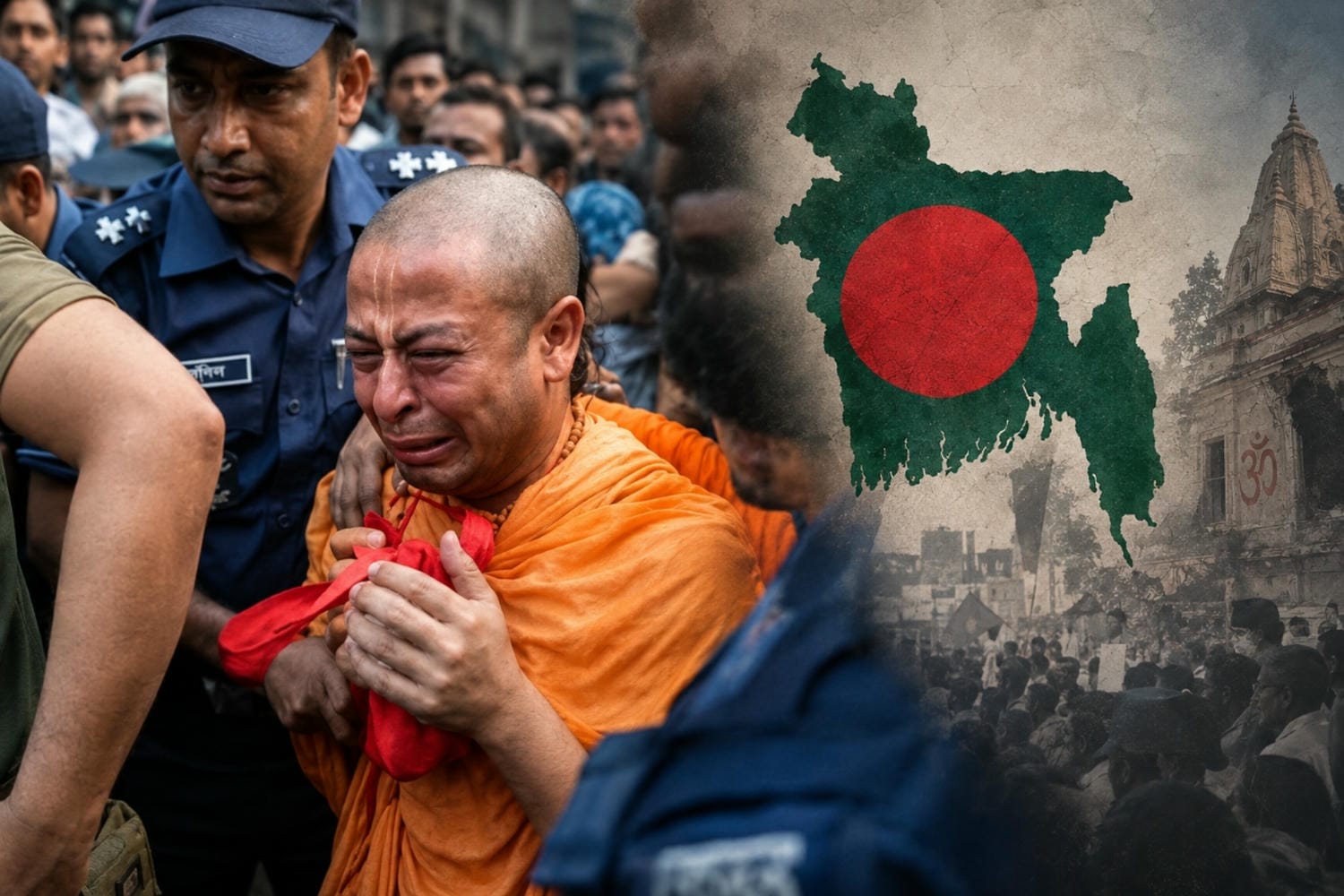
Thursday, 27th August 2026. No matter how far one may be from their homeland, one’s roots cannot be forgotten. Despite the thousands of miles of distance, no matter the different way of life, the chilling story of the mass killing of the Chakraborty family has shaken Hindus around the world. Less than a year after the horrifying images of Dipu Das’s death surfaced, the brutal killing of teacher Ganapati Chakraborty and his family is truly devastating.
In a country that once loudly championed its religious diversity, this massacre lays bare the grim and ugly face of a new nation that is increasingly consumed by religious intolerance and the darkness of ignorance. The ugly face of social values, of the failure to protect, does not trouble them; lives like Ganapati, Agami, Dipankar, and Sonath are being extinguished in the intoxication of violence by a handful of extremist, fanatical people.
Despite enduring so much hardship, the tears of the Hindu people who have stayed rooted to their ancestral land for so long weigh heavily on their compatriots abroad. What will happen next time?
Whenever questions arise about the safety, rights, and existence of people on the other side, their echo reaches the diaspora as well. That emotion, that anxiety, and that sense of human responsibility resonated in the voice of protest that was held in London.
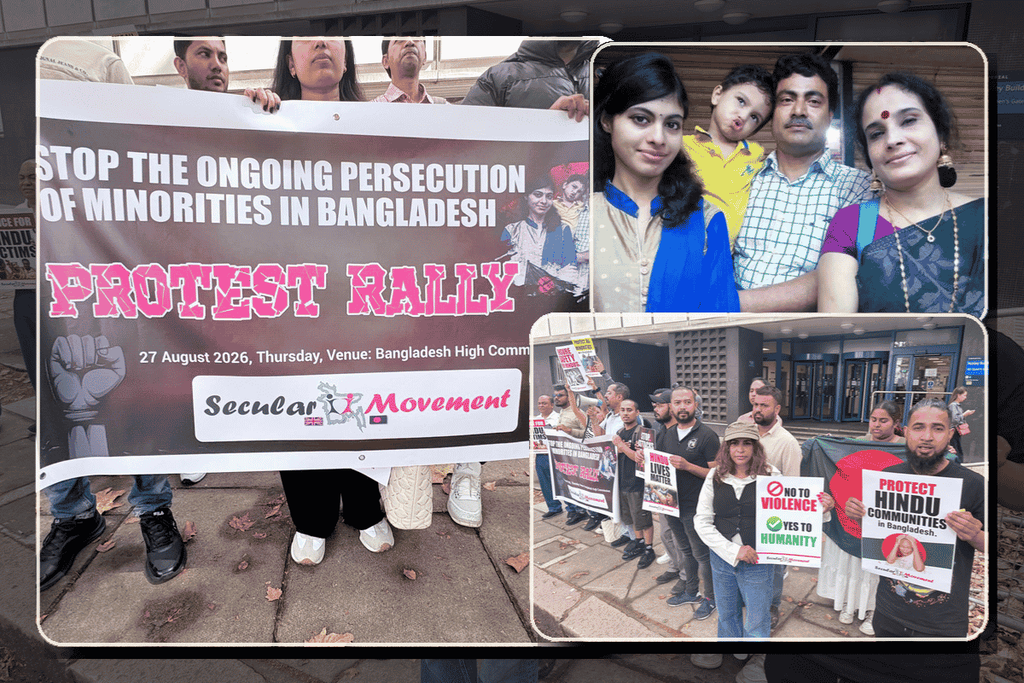
On the initiative of the Secular Bangladesh Movement, on Thursday, 27 August 2026, a protest was held in front of the Bangladesh High Commission in London. The poster for the protest stated clearly, “Protest Against the Ongoing Persecution of Minorities in Bangladesh”, meaning the protest was against the alleged ongoing persecution of minorities in Bangladesh, along with a demand to ensure their safety and rights.
This protest is not just a banner, a few slogans, or a gathering. Within it lies a kind of anguish felt from a distant land for one’s own country, along with a few questions: Can every person in a country not live with equal safety, respect, and rights?
Does being a minority mean being weak? Does being a minority mean being different? A person may differ in religious or cultural identity, but their tears, their dreams, their family- all of these are human. Yet why does this relentless cycle of bloodshed continue in Bangladesh? Ganapati Chakraborty perhaps did not even know that the fire of religious hatred could become so terrible; perhaps he could have fled to a neighbouring country, but why should he have to flee at all? Like the majority in Bangladesh, he too had rights. Perhaps thinking of all this, he had held his ground for so long. And did they forget Dipu Das, the boy who was burned alive in Bangladesh? Did the administration’s attention ever fall there? Are they really just a Hindu minority? The Western media remains utterly silent, because it does not fit within any narrative that they wish to present.
The decision to protest on London soil, in front of the Bangladesh High Commission, may become the voice of conscience for a section of the diaspora. Their relationship with Bangladesh is one of memory, of family, of language, of culture, and of the final pull of their roots. If any person in that ancestral homeland lives in fear, that fear inevitably creates unease in the minds of those abroad as well.
Let the clenched fists on the poster be a symbol of that very unease today, a resolve to stand against injustice, the courage to raise a voice for justice, alongside a commitment to protect rights.
But the power of protest is at its most powerful when humanity lies at its centre, not hatred against any community, not revenge against any individual, but a demand for equal rights, safety, and dignity for all; that should be the language of this protest. Let the truth emerge through impartial investigation into any allegation of persecution against minorities; that alone would be enough.
If today a few voices rise together on the streets of London, may their echo reach far away, into every home in Bangladesh, into every person’s heart. Let that message be simple:
“Not fear, but safety.
Not discrimination, but equal rights.
Not hatred, but harmony.
A life of dignity for every person.”
The true beauty of a country lies not in the strength of its majority, but in how safely, securely, and with how much dignity its minority can live; that is where its humanity is revealed.
So let this call for protest raised today in distant London be one for the greater good, for an identity of Bangladesh in which identity is not defined by religion, where humanity returns first, where peace returns, where no citizen ever needs to fear for their very existence.