In the annals of Indian history, few rulers have left as controversial and lasting an impact as the tyrannical Emperor Aurangzeb. His nearly fifty-year reign of terror would forever alter the religious and cultural landscape of the Indian subcontinent.
Read the full series here: Islamic invasion of India: The neglected history of colonialism
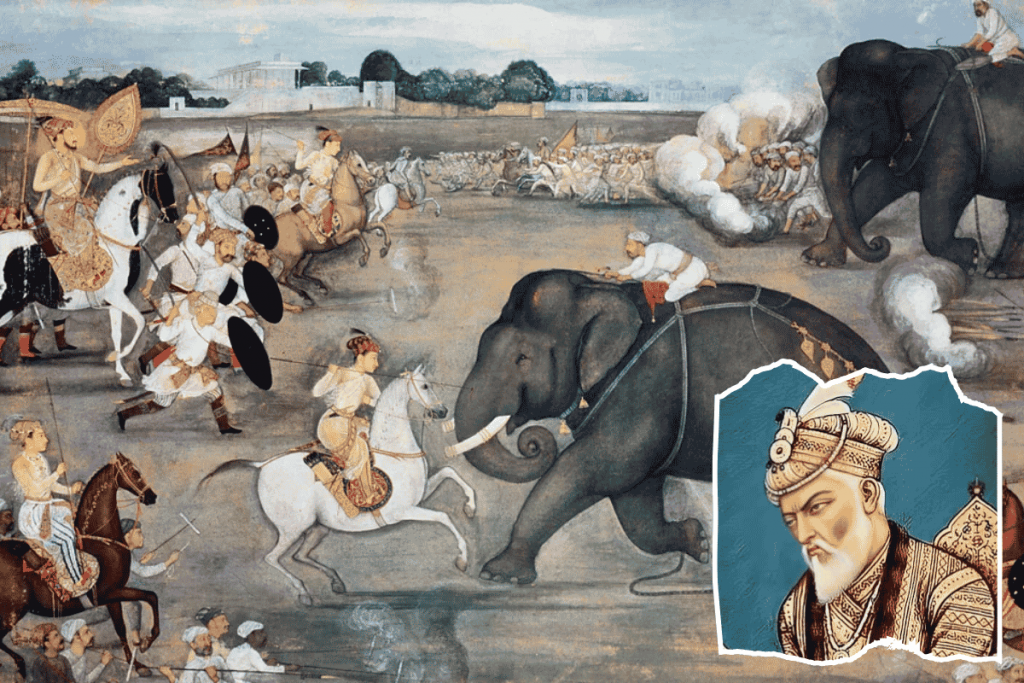
His ascension to power came through a trail of bloodshed that would foreshadow the nature of his rule. He imprisoned his own father, Shah Jahan, and orchestrated the execution of his elder brother, Dara Shikoh, in his relentless pursuit of the Mughal throne. Often romanticised by imperial and post-colonial narratives as a pious ruler, Aurangzeb’s rule from 1658 to 1707 stands out as a dark period of religious bigotry, cultural destruction, and state-sponsored persecution, especially against the Hindu community.
Aurangzeb was born in 1618 as Muḥī al-Dīn Muḥammad in Dahod, Gujarat, the third son of Shah Jahan and Mumtaz Mahal. Unlike his elder siblings, Aurangzeb showed early signs of deep religiosity and rigid orthodoxy. He was a devout Sunni Muslim and took to heart the Islamic injunctions he was taught as a young man. As he matured, his piety transformed into intolerance, which was evident in both his personal and administrative decisions. The path to the throne was bloody; in the classic Mughal tradition, he engaged in a ruthless war of succession against his brothers, notably Dara Shikoh, who represented a more syncretic and inclusive version of Islam. Aurangzeb not only defeated Dara militarily but also had him executed on charges of apostasy. Once he imprisoned his own father and seized the throne, Aurangzeb set about transforming the empire according to his vision of Islamic governance, a vision that had little space for religious plurality.
What followed was a systematic campaign of religious repression and cultural erasure. One of Aurangzeb’s most infamous policies was the state-sanctioned destruction of Hindu temples. These were not isolated or reactive incidents, as some revisionist historians have claimed. They were calculated acts of domination, intended to both humiliate and erase the spiritual centres of the Hindu civilisation. Temples in Mathura, Kashi, Somnath, and countless villages were razed to the ground, often replaced by mosques to symbolise the supremacy of Islam over “idolatry.” These actions were chronicled in official court records and contemporary Persian chronicles, leaving no ambiguity about the emperor’s intent. Such desecration was more than symbolic; it was psychological warfare, designed to demoralise an entire civilisation.
Aurangzeb also reinstituted the jizya tax, a poll tax historically levied on non-Muslims under Islamic law but abolished by his great-grandfather, Akbar. Its reinstatement in 1679 was a clear declaration of second-class citizenship for Hindus under Islamic Mughal rule. The jizya wasn’t just an economic burden; it was a mechanism of subjugation. Those who could not pay faced humiliation, loss of property, or conversion. This law sent an unmistakable message: conformity or suffering. Hindus were further targeted through the dismissal of their officials from government posts, bans on religious festivals like Holi and Diwali, and prohibitions on architecture and dress that might challenge Islamic superiority. Cultural suppression seeped into every facet of daily life, from the music once cherished at court to the education of Hindu children.
Aurangzeb’s bigotry was codified in law. He commissioned the Fatawa-i-Alamgiri, a massive compendium of Islamic jurisprudence that institutionalised discrimination against non-Muslims. This legal code reinforced orthodox Sunni interpretations of Sharia law, particularly those that defined Hindus as dhimmis, protected yet inferior, subjects. While the laws applied in varying degrees across his vast empire, the message was clear: religious freedom would be sacrificed at the altar of imperial Islam. The Fatawa didn’t merely reflect his personal beliefs; it shaped Mughal governance, empowering local officials to impose discriminatory laws with impunity. Hindu temples required special permissions for even minor repairs, while new ones were forbidden altogether. In court disputes between Hindus and Muslims, the presumption of credibility tilted heavily in favour of the muslim, reinforcing systemic injustice.
Predictably, such tyranny provoked fierce resistance. The most formidable came from the Marathas, led by Chhatrapati Shivaji Maharaj, who carved out an autonomous kingdom rooted in Hindu dharma and indigenous pride. Shivaji Maharaj’s resistance was not merely political; it was civilisational. He defended the rights of Hindus to worship freely, to govern themselves, and to reclaim the heritage that Aurangzeb sought to obliterate. In the north, the Rajputs, long-time allies of the Mughals under Akbar and Jahangir, turned hostile, rebelling against the emperor’s attempts to override their autonomy and suppress their faith. Even the Sikh community, previously aloof from Mughal internecine politics, was drawn into the conflict. The execution of Guru Tegh Bahadur in 1675 for refusing to convert to Islam was a turning point that transformed the Sikh ethos into a martial force. Each of these resistances was not just against imperial oppression, but against the erasure of a pluralistic Hindu-Indian ethos.
Aurangzeb ruled for nearly 50 years, longer than any Mughal emperor before or after. Yet, by the time of his death in 1707, the empire was exhausted, fragmented, and morally bankrupt. While he expanded the geographical boundaries of the empire, he failed to secure its soul. His policies alienated major segments of the population and sowed the seeds for the empire’s eventual collapse. The Mughal dynasty, once a symbol of “grandeur” and “unity”, became a shell of its former self within decades of its death. The psychological scars of his reign lingered far longer. For the Hindu community, his rule represents political subjugation and a full-spectrum assault on identity, dignity, and continuity.
In Pakistan, Aurangzeb is often portrayed heroically as a devout and principled ruler who expanded the Islamic Mughal Empire while upholding Islamic values. Textbooks and state narratives emphasise his personal austerity, describing him as a pious Muslim who sewed caps and copied the Qur’an to support himself, and celebrate his implementation of sharia and the jizya tax as marks of religious commitment (Mubarak Ali; BBC Urdu documentary cited in The Daily Guardian). Haroon Khalid notes that he is remembered as a “true believer” who purified the court and fought to expand the frontiers of Islam, while historian Munis Faruqui observes that he is included in Pakistan’s pantheon of Muslim heroes for his militarism, piety, and moral governance. Some Pakistani history texts even frame his reign as strengthening the “Pakistan spirit,” portraying his death as a turning point in its decline.
Decolonising Hindu history can begin with Aurangzeb by placing the experiences of Hindus during his reign at the forefront of the narrative. His rule was marked by temple desecrations, the imposition of the jizya tax, suppression of cultural practices, and systemic discrimination through laws such as the Fatawa-i-Alamgiri. These actions provoked enduring resistance from figures like Chhatrapati Shivaji Maharaj, the Rajputs, and the Sikh Gurus, whose struggles embodied the defence of pluralism and indigenous traditions. Re-centring these voices and experiences challenges the distortions of colonial and post-colonial narratives that have often downplayed the scale of persecution, allowing for a more honest engagement with the past and a reclamation of Hindu history on its own terms.