In the global political arena, a calculated, multi-pronged campaign is underway against the world’s largest democracy. What is peddled to the uninitiated as organic domestic dissent or independent journalistic critique is, upon closer inspection, a synchronised assault. This is a deliberate blueprint driven by an unholy convergence and political convenience: a domestic radical-left ecosystem, foreign influence levers, and a far Islamo-Left Western media cartel working in lockstep to destabilise sovereign administrative processes.
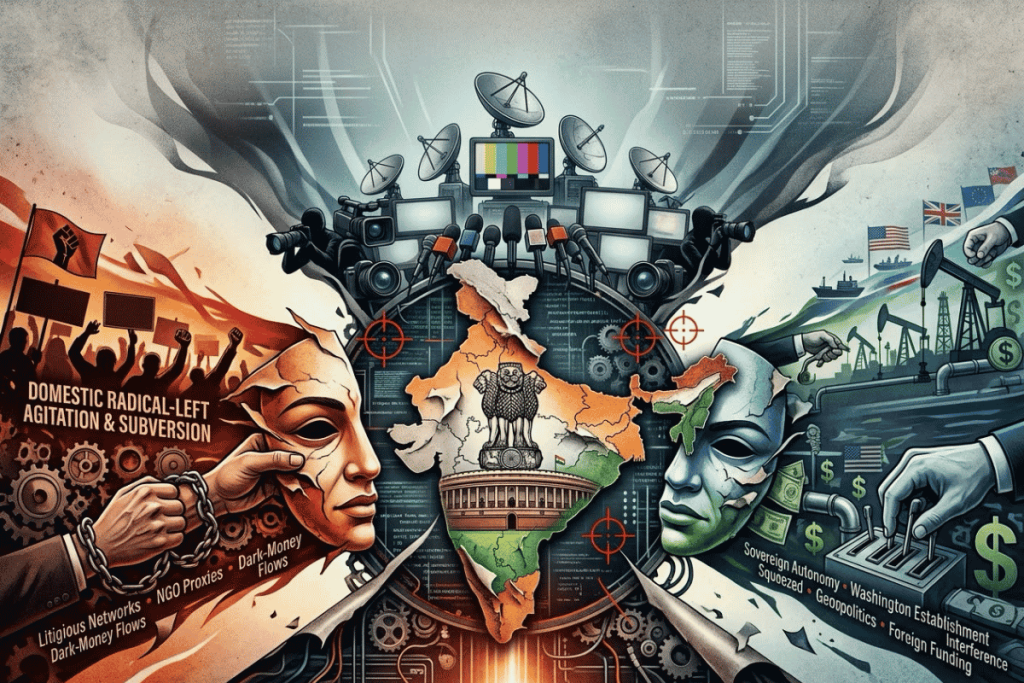
The reasons for this coordinated attack on the world’s largest democracy should raise severe concerns among the so-called greatest advocates of democracy. Instead, we see these self-appointed custodians of global values acting in the exact opposite manner. Only one of these positions can be true. The fact remains that despite its immense internal complexities and challenges, India has consistently maintained a robust democratic administration anchored strictly in its sovereign constitution and the rule of law.
This overview article serves as the opening salvo of a definitive investigative series. In the coming weeks, our reports will tear down the facade, exposing the mechanics, collusions, and ideological coordination connecting every node of this matrix.
Part I: The domestic radical-left axis, manufactured agitation, and subversive funding
The first pillar of this subversion operates within India’s own borders, where radical litigious networks and opposition fronts act as force multipliers for external interests. Organisations like the Cockroach Janta Party (CJP), along with elements of the Congress-led INDIA bloc, systematically convert localised political grievances into global anti-India campaigns.
Nothing in this ecosystem happens by coincidence:
- The Orchestrated Agitation: Why did activist groups and their allied political actors organise street protests immediately following foreign political commentary on Indian tariffs and commercial talks involving foreign tech executives? This pattern is far too convenient to be dismissed as mere coincidence.
- Legal Interference and Foreign Funding: For years, foreign-funded networks, including subversive, coercive evangelical organisations, poured billions into Indian civil society under the guise of social and charity work. The moment the Indian government tightened Foreign Contribution Regulation Act (FCRA) laws to audit these dark-money flows, international political bodies immediately launched coercive campaigns, weaponising the narrative of “religious freedom” to interfere with India’s sovereign right to secure its financial channels and national security.
Part II: Foreign overreach, energy imperialism, and sovereign autonomy
The second pillar involves foreign political and corporate apparatuses using institutional and economic leverage to dictate terms to a sovereign state. For decades, Western establishments have preached free-market economics and sovereign autonomy while subverting both whenever independent nations act outside Western preferences.
- The Energy Sovereignty Paradox: Why does the Washington establishment raise eyebrows when two sovereign nation-states, Russia and India, agree to conduct natural oil business strictly on the basis of national interest, energy security, and market pricing? The double standard becomes glaring when examining history: the US has repeatedly used explicit foreign invasions, military stratagems, and coercive politics masked as “restoring democracy” to secure oil resources across the world. In the past 2 years, the world has seen this evidence – from interventions in Venezuela to geopolitical manoeuvres in Colombia, Guyana, and resource bids over Greenland. Yet, when India secures energy for its 1.4 billion citizens, it is branded a geopolitical threat. Ironically, Washington announced an agreement with Russia to import hundreds of thousands of barrels of fuel (diesel) to lower fuel prices ahead of midterm elections in the US.
- Corporate Political Double Standards: Why does tech billionaire Elon Musk feel entitled to comment on industrial campaign contributions in Indian elections, despite having lobbied heavily, poured immense financial capital, and pulled political levers during domestic US election campaigns? This attempt to project American corporate oversight onto Indian democratic processes highlights a persistent attitude of foreign interventionism.
- Regime Change Operation: Intelligence analysts and political commentators warn of a sophisticated foreign-orchestrated regime change playbook in motion. The telltale signature, observers argue, is not just the rapid escalation from local grievances to coordinated street blockades, but the strategic deployment of the iconic One Piece “Straw Hat Pirates” symbol across major protest hotspots. Having already surfaced during the recent Gen-Z uprisings in Nepal and Bangladesh, the cross-border appearance of this uniform pop-culture imagery—worn prominently by student leaders—points to a familiar “colour revolution” blueprint designed to weaponise organic youth frustration, signal transnational solidarity, and destabilise state institutions through curated street spectacle.
Part III: The Islamo-Left media cartel, diaspora targeting, and the silence on terror
The third pillar of this axis is the global media infrastructure, which comprises outlets such as The New York Times, The Guardian, BBC, and Al Jazeera. These publishers act as the propaganda amplification arm for this nexus.
This cartel extends its narrative warfare beyond domestic news, targeting the diaspora and silencing Indian heroism:
- Sustained Hate Campaigns Against Indian Citizens: In Western political corridors, elected members of legislative bodies and political elites routinely indulge in sustained, subtle hate campaigns against Indian-American and Indian-European citizens which amount to overt “brown shaming” and systematic stereotyping under the guise of domestic political debates. The contrast between how Western media mocked the early setback of Chandrayaan-2 versus the reluctant, backhanded coverage of Chandrayaan-3’s historic lunar landing serves as a textbook example of this condescension.
- Weaponised Visa Delays: The targeted, artificial visa delays, backlogs, and disproportionate rejections handed out to Indian professionals and students by Western diplomatic missions (across the US and EU) serve as a soft-power coercive tactic to bottleneck Indian global mobility and economic integration.
- The Deafening Silence on Terror: While Western and Middle Eastern media outlets churn out continuous commentary attempting to paint India as unstable, they maintain a revealing silence when confronted with the reality of Islamist terrorism foiled by Indian courage. Consider the recent terror attempt aboard flydubai Flight FZ1073 from Dubai to Tel Aviv, where a radicalised co-pilot launched a violent cockpit assault to hijack the plane. Despite suffering critical injuries, Indian Captain Smit Machchhar courageously fought back, secured the cockpit, and landed the plane safely. The global media ecosystem largely minimised the explicit jihadist terrorist motivation behind the attack. An Indian pilot foiling a radical terror plot shatters the manufactured narrative of Muslim victimhood that these outlets rely on to advance their political agenda.
The tip of the iceberg
What is visible today is merely the surface of a far deeper network. The web of foreign funding, ideological subversion, NGO proxies, and coordinated media manipulation runs vastly deeper than public discourse currently reflects.
In our upcoming multi-part investigative series, we will thoroughly expose each element:
- FCRA Enforcement & Legal Terrorism: Tracking dark-money pipelines, NGO networks, and litigious fronts attempting to bypass Indian financial oversight.
- Resource Imperialism & Geopolitical Coercion: Exposing the historical and current foreign manoeuvres used to manipulate global energy markets while penalising sovereign nations like India.
- Institutional Discrimination & Diaspora Targeting: Documenting systemic visa coercion, institutional anti-Indian bias in Western political bodies, and narrative suppression by global media desks.
India’s constitutional sovereignty and democratic governance remain resilient.
The upcoming exposés will present the evidence in full detail, leaving no room for ambiguity.
References and Sources
- Ministry of Home Affairs (MHA), Government of India: Foreign Contribution Regulation Act (FCRA) foreign funding oversight mechanisms, compliance guidelines, and enforcement reports.
- Ministry of External Affairs (MEA), India: Official statements regarding national energy procurement, sovereign trade decisions, and diplomatic responses to international visa backlogs and external commentary.
- National Investigation Agency (NIA) & Civil Aviation Security Reports: Official documentation and legal filings regarding anti-hijacking measures, security incidents, and the cockpit attack aboard flydubai Flight FZ1073 involving Captain Smit Machchhar.
- U.S. Congressional Records & Diplomatic Policy Papers: Public records detailing foreign energy intervention history, international sanction frameworks, and diplomatic engagements in Latin America.