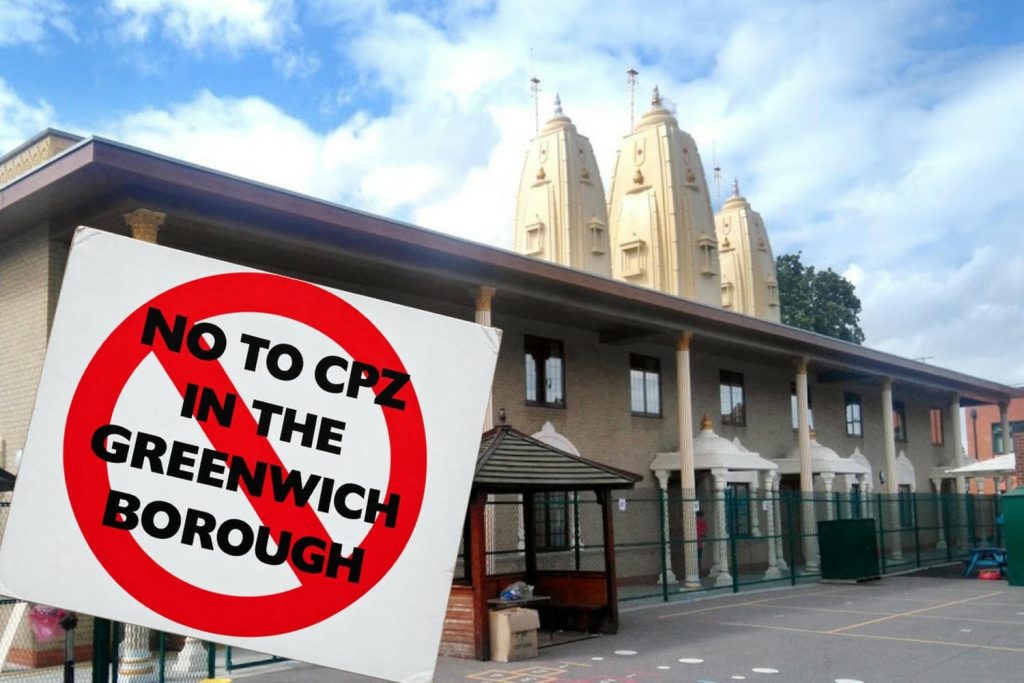
Shree Kutch Satsang Swaminarayan Temple calls on Royal Borough of Greenwich to reconsider pay-and-display restrictions on St Margaret’s Grove after a petition of more than 800 signatures went unanswered.
What has been decided
Greenwich Council has passed a controlled parking zone that includes St Margaret’s Grove, close to the Shree Kutch Satsang Swaminarayan Temple. Parking will be pay and display. The decision has been made, and the scheme is going ahead.
The council ran a statutory consultation on its Woolwich proposals over 21 days earlier this year. It received 252 submissions: 168 were clear objections, 74 raised concerns, and only 10 were positive. The consultation covered the wider Woolwich proposals, not only St Margaret’s Grove, but the result shows how little support the scheme had among those who responded.
Why this matters to worshippers and families
Worship. For many devotees, the temple is not somewhere they can simply walk to. Worshippers travel from across south-east London and rely on being able to park close by.
The nursery. The temple runs a nursery on weekdays with 26 children. Parents and carers need to stop briefly, twice a day, to drop off and collect very young children from ages 2 to 5. Under the new zone, those short stops would become paid, and parents face the risk of a penalty charge. This affects families of all backgrounds who use the nursery, not only worshippers.
Getting there without a car. Public transport is not a practical substitute for many. The nearest bus stops are on Plumstead Common Road, a busy main road at least 300 metres from the temple. Elderly worshippers, families with young children and parents dropping off their child at the nursery would have to cross that road to reach the temple. Tragically, an elderly devotee died on this road after being struck by a car while travelling to the temple. Paying to park, or being limited in how long they can stay, is likely to discourage attendance, and for many people that means being cut off from their place of worship or having to rethink their childcare.
Health and safety of children and families
For the temple, another serious concern with the scheme is safety. At present, parents and worshippers can stop close to the nursery and the temple on St Margaret’s Grove. Once parking there is paid and time-limited, many will have to find another way in. For those without a car, that means the bus, and for those who drive it means stopping further away. Either way, they are likely to end up on foot, crossing Plumstead Common Road with children aged 2 to 5.
Plumstead Common Road is a busy main road. The crossing on the route between the nearest bus stops and the temple is an island crossing, which was added after the elderly devotee’s death. It is still not a controlled crossing, meaning there is no zebra crossing or traffic lights to stop the traffic. An island lets pedestrians cross in two stages, but it does not stop the traffic, so parents and carers must still find a gap on each side, holding the hands of their child or children and managing bags or buggies. They would have to do this twice a day, five days a week, in all weather and in the dark winter mornings and evenings. Although the island was added, the temple believes it is still not safe enough for the elderly and very young children.
This is not a hypothetical risk. As mentioned earlier, an elderly devotee has already died on this road after being struck by a car while travelling to the temple. A scheme that pushes more families, and more very young children, onto the same road should have been accompanied by a serious assessment of the danger. The temple is not aware of any such assessment, and the council has not engaged with the temple to discuss it.
The temple’s question to the council is a simple one: how does it expect parents with young children to cross a busy main road safely?
Equality and religious freedom
As a public authority, Greenwich Council has a legal duty to have due regard to the impact of its decisions on people of different faiths, ages and abilities, and must act compatibly with the right to freedom of religion. The temple is asking how these duties were considered in approving this scheme, including whether an equality impact assessment was carried out or substantiated, and how it concluded that a place of worship and nursery with elderly and very young users will not be impacted.
The temple’s attempts to engage the council
The temple organised a petition against the restrictions, signed by more than 800 people. It then chased the council for updates, and requested a meeting to discuss the concerns. Despite the meetings and all the concerns raised, the council eventually replied to say the scheme would go ahead, and it was not willing to discuss or negotiate.
“The council spent taxpayers’ money on a consultation, yet it seems to have had no intention of considering the feedback. If going ahead with the controlled parking zone was a foregone conclusion, why go through the motions of a public consultation at all?”
~ Diya Kerai, Temple worshipper and a local resident
The temple’s position is that a scheme affecting a place of worship and a working nursery, and opposed in the consultation by a large majority of respondents, deserved a proper conversation with the community it affects.
Scheme was dropped elsewhere but not near the temple
Greenwich Council originally proposed its Sustainable Streets parking scheme across large parts of the borough. After strong public opposition, it scrapped the plans in almost every area. Proposals for Shooters Hill and Plumstead were dropped in the summer of 2025, and those for Charlton, Kidbrooke, Blackheath and West Thamesmead followed in December 2025. Only Woolwich was kept. Critics had branded the scheme a “cash grab”, and the council leader said the council had listened because support in those other areas was limited.
St Margaret’s Grove sits in the part of Woolwich that was kept, (on its edge, next to Plumstead Common, where the scheme was scrapped). Yet the response here has been just as clear. Of the 252 submissions to the Woolwich consultation, 168 were clear objections, 74 raised concerns and only 10 were positive, and the temple’s own petition gathered more than 800 signatures objecting to the scheme.
The temple’s question is a simple one. If public opposition was reason enough to withdraw the scheme elsewhere, why is it not reason enough here? What makes the streets around a place of worship and a nursery different from the areas where the council listened? So far, the council has not explained.
What the temple is asking for
The temple’s preferred outcome is that the restrictions are removed entirely for St Margaret’s Grove. If the council will not do that, the temple asks it to consider, in order of preference:
- A time-limited weekday scheme, Monday to Friday only, with a maximum stay of two hours.
- Restrictions only at specific times, for example between 11 am and 5 pm, so that worship outside those hours is unaffected.
The temple also asked for a meeting with the council to discuss these options directly, and for the council to publish its evidence collected to justify their conclusions on the equality impact assessment for this scheme.
The temple also asks the council to publish any road safety assessment it carried out for children and families crossing Plumstead Common Road, and to say whether it will provide a controlled crossing, such as a zebra crossing or traffic lights, if the scheme goes ahead.
The temple also asks the council to explain why the principle of listening to public opposition, applied in other areas, was not applied to St Margaret’s Grove, and to publish the parking-pressure evidence it relied on for this specific street.