The slur began as a joke, travelling through school corridors and living-room arguments before resurfacing on a protest placard. But the story of “coconut” stretches far deeper than one word or one incident: from grooming-gang victims labelled for acting “too white” to politicians mocked for supposed assimilation, it reveals the tensions tearing through diaspora communities. Its power lies not in what it says about whiteness, but in what it demands of those who are not white, exposing a quiet, persistent struggle over who gets to belong, and who is cast out.
There are words that move quietly through a community, whispered, joked about, tossed lightly between friends, but which carry the weight of entire histories. Words that appear harmless, even playful, until you trace the shadows they cast across memory.
“Coconut” is one of them. At first glance, it seems almost childish, a fruit repurposed as a taunt, something that might pass unchallenged in a school corridor or family gathering. Yet beneath its surface lies an entire apparatus of belonging and exclusion, a subtle code that tells people who they are allowed to be, how far they may stray, and what it means to be “one of us.”
In the lexicon of diaspora life, “coconut” is a boundary stone. It marks the line between the acceptable and the suspect, the culturally loyal and the allegedly assimilated. Its meaning is simple: brown on the outside, white on the inside. But coded within that simplicity is a powerful accusation, that a person’s identity is counterfeit, their loyalties misplaced, their cultural skin merely a façade that hides an interior whiteness. For many, the term is delivered with a smile or a laugh, an ostensibly innocent dig. Its purpose is never innocent. Its purpose is policing.
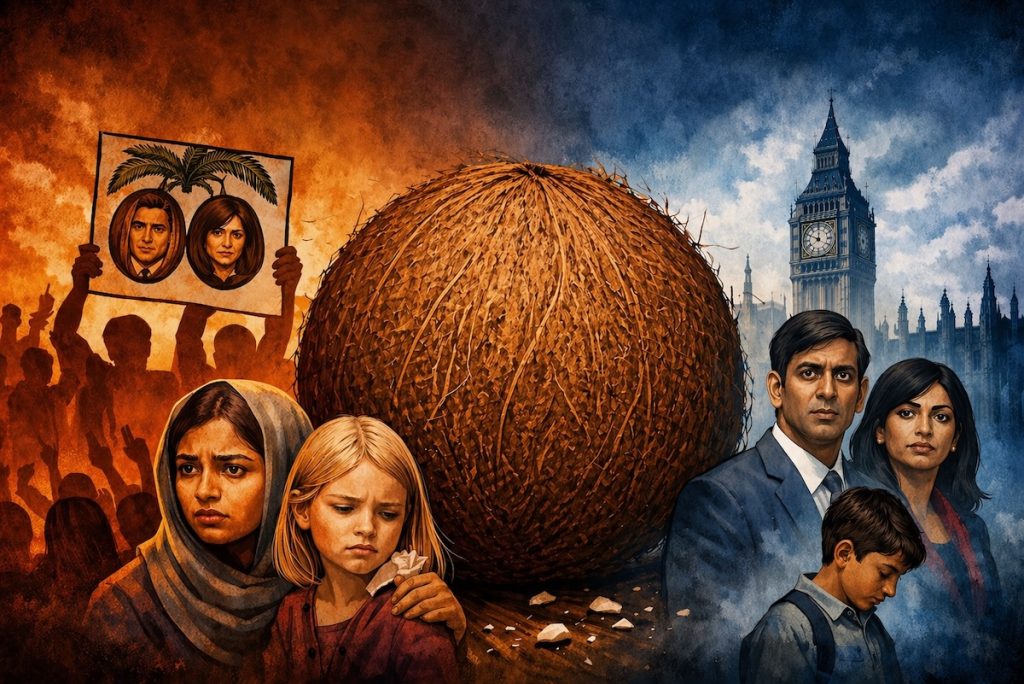
This became clear once again when British Pakistani Muslim teacher Marieha Hussain held aloft a placard at a pro-Palestine protest. Her poster depicted the faces of Rishi Sunak and Suella Braverman superimposed onto coconuts dangling from a palm tree. There was no mistaking the implication. Here were two brown politicians recast as coconuts, brown-skinned but, in her view, white-aligned. Later, in court, a judge acquitted her, deciding that the poster fell within the bounds of political satire and that prosecutors had not met the criminal standard required to prove racial abuse. But the judicial question was narrower than the cultural one. Whatever the courtroom concluded, the placard revived an old conversation: why does this particular slur resonate so sharply? Why does it surface so often when communities speak about their own?
The weaponisation of the “Coconut” slur
Long before Hussain took her poster into the street, this language was already deeply enmeshed in Britain’s racial landscape. It had been heard in classrooms, family arguments, and student unions. It had appeared in community newspapers, in diaspora literature, in whispered gossip and shouted disagreements. It has appeared too, and this is the part that polite society often overlooks, in some of the darkest chapters of Britain’s recent history.
Over the past decade, Britain has been forced to reckon with a series of grooming scandals in which groups of predominantly Pakistani Muslim men exploited vulnerable girls in towns such as Rotherham, Huddersfield, Oxford and Telford. These were not isolated crimes but organised patterns of coercion and abuse that went unnoticed or unchallenged for decades. The perpetrators often used the language of race and religion to mark their victims — white, Hindu, Sikh and even Muslim girls — as inferior or impure. The legacy of these cases lingers still, a reminder of how violence can hide in plain sight when communities and authorities fail to confront the prejudices operating within their own walls.
In the Pakistani-Muslim grooming gangs, the slur “coconut” was not a joke; it was a weapon.
One survivor, known publicly as Ella Hill, wrote in the Independent in 2018 about the abuse she suffered as a teenager. Her account was stark: “As grooming victims, my friends and I were called vile racist names such as ‘white trash’ and ‘kaffir girl’ as we were raped. Our Sikh and Hindu friends… were called ‘kaffir slags’ too. Muslim rape victims were called ‘coconuts’ for acting ‘white’, a term that is racist to both brown and white people at the same time.” In that single recollection lies the architecture of domination: the non-Muslim victim cast as religiously inferior, the Muslim victim castigated as culturally impure, the entire process underwritten by the perpetrators’ belief that Westernisation, even imagined Westernisation, justified control.
The language was not incidental to the violence. It gave the violence a moral frame. To call a Hindu or Sikh girl a “kaffir” was to position her outside the perpetrators’ moral universe. To call a Muslim girl a “coconut” was to imply she had forfeited her community’s protection by acting “too white.” The slur did ideological work: it sorted victims into categories of worth and unworthiness.
Years later, when Hussain stood in a crowd holding a placard that labelled two brown politicians as coconuts, the circumstances could not have been more different. There was no violence, no horror. But the cultural logic, insiders judging insiders and outsiders according to a standard of acceptable brownness, felt hauntingly familiar. The medium had changed; the underlying grammar had not. Once again, identity was on trial.
The boundary marker
Academic research helps illuminate how deeply this grammar is embedded. Studies archived in White Rose eTheses Online, drawing on interviews with South Asian youth in Britain, reveal that “coconut” has functioned for decades as a form of social regulation. One young participant described it like this: “If you dress a certain way or have white friends, they’ll call you a coconut straight away, like you’re a fraud.” Another said: “It’s basically a warning: stay in your lane or you’re not one of us anymore.” In these accounts, the slur acts as a boundary marker. It signals that cultural behaviour must align with group expectations, that deviation, however mild, risks expulsion.
This disciplining function appears beyond youth culture, too. In analyses published in War on the Rocks, former Islamist group members recount how they were shamed as “coconuts” or “sell-outs” for engaging in mainstream civic life, from joining public institutions to embracing friendships outside the community. One former member recalled: “They said I was a coconut because I wanted to get involved in normal British life, like I’d betrayed the faith.” In these narratives, the term becomes a charge of religious failing as much as cultural betrayal.
The slur’s presence in political life is not new either. In 2010, during a council debate in Bristol, Liberal Democrat councillor Shirley Brown called Conservative councillor Jay Jethwa “a coconut,” resulting in a conviction for racially aggravated harassment. Its meaning, and the harm it caused, was recognised by the courts long before the events of 2024.
“Coconut” – a family of edible metaphors
To understand the full emotional palette of the term, it helps to explore its wider diaspora history. “Coconut” belongs to a family of edible metaphors used across minority communities to express anxieties about assimilation. In East Asian American contexts, “banana”, yellow outside, white inside, has been used for decades. For Asian Americans, “Twinkie” occupies similar territory. For Black or mixed-race individuals, “Oreo” or “Bounty” capture the same charge. The Juggernaut, an online publication dedicated to South Asian diaspora stories, traces how “coconut” gained traction as a way to shame those seen as assimilating too readily into white-majority cultures. The article offers striking examples: when Kamala Harris became the Democratic vice-presidential nominee in 2020, memes circulated comparing her to a coconut, implying that her political persona was shaped by whiteness. Bobby Jindal was mocked with the hashtag #bobbyjindalissowhite. Nikki Haley was accused of “burying every trace” of herself under an anglicised identity.
Such logic is not confined to South Asian communities; it travels across minority experiences wherever identity becomes something to be monitored from within. In the United States, for instance, Barack Obama spent much of his presidency shadowed by insinuations that he was “not Black enough,” a critique that said far more about the anxieties of his accusers than about the man himself.
Cory Booker experienced a sharper, more immediate version of this dynamic during his Newark mayoral race, captured in the documentary Street Fight. There, men shout at him on the pavement, “you ain’t Black, you suspect”, as though his very presence in politics, his grammar, his education, his polish, rendered him racially counterfeit. One commentator in the film reflects on the contradiction with painful clarity: “We ask our Black children to be educated, and they do, and we call them white. It’s sad, truly sad.” Kamala Harris has endured similar accusations of inauthenticity, dismissed with the slur “Oreo,” another food metaphor that inverts skin and interiority to question legitimacy.
These examples underscore a universal tension: when people of colour ascend into public life, the boundaries of their communities tighten around them, and the scrutiny of authenticity intensifies. The test is not whether they succeed, but whether they succeed in the right way, with the right tone, embodying the right script for their community. And if they deviate, even slightly, the charge is familiar, almost ritualistic, that their exterior no longer matches the story they are expected to inhabit.
Shaped by colonialism, migration and generational change
The anxieties that animate these accusations are not trivial. They emerge in communities shaped by colonialism, migration and generational change, communities trying to preserve cultural distinctiveness while also navigating the demands of a Western society in which assimilation has long been framed as a condition for success. The slur becomes a signpost for deeper fears: if someone “acts white,” what does that mean for the community? How fragile is identity when one of its own appears to drift beyond its imagined borders?
Look to online forums and these fears become visible in their most candid expressions. “Coconut is a derogatory term saying that the person appears brown but behaves like a white person,” one Reddit user wrote, not as a critique but as a clear-eyed definition. Another expanded the scope: “Coconut is a sort of all-purpose, you’re-white-on-the-inside epithet for all manner of brownness, Desis, Latinos, Afro-Caribbeans.” These voices, unfiltered and anonymous, reveal a truth often obscured in mainstream discussions: the slur survives because it articulates a communal anxiety, one that remains unresolved.
Even public figures are not immune to its reach. When journalist Amol Rajan found himself embroiled in an online controversy, he wrote afterwards: “Thousands more called me a ‘coconut’. (I prefer ‘Bounty’.)” His humour softened the blow but did not erase the underlying accusation that his professional success, his tone, and his style marked him as insufficiently authentic.
The uncomfortable parallel
And there is another, more uncomfortable parallel that emerges, one that sits beneath the surface of public debate but is impossible to ignore. In the grooming gang cases, Pakistani-Muslim perpetrators often drew an implicit line between themselves and the non-Muslim girls they targeted, using slurs like “kaffir” to mark those girls as outside their moral community and “coconut” to chastise Muslim victims who had, in their view, strayed too far from expected norms.
That same pattern, insiders policing outsiders and near-insiders alike, quietly echoes in Hussain’s decision to direct the slur at two non-Muslim figures, one of whom, Rishi Sunak, has spoken openly and proudly about his Hindu identity.
For a British-Pakistani-Muslim teacher, trained in multicultural education and fully aware of religious symbolism, the choice takes on a specific resonance. The coconut holds deep ritual meaning in Hinduism, offered in devotion, broken in prayers and used to mark purity and consecration. To repurpose that same word into an accusation aimed at a Hindu man whose heritage is woven into his public life suggests not ignorance but intention: a turning of cultural symbolism against the person whose community reveres it.
The dynamic is not equivalent in severity to the horrors of the grooming gangs, but the architecture is hauntingly familiar, a Pakistani-Muslim voice positioning non-Muslims, including a Hindu, as counterfeit, insufficient or suspect. It is the same old grammar of insiders and outsiders, repurposed for the demands of contemporary political expression.
Time to root out the racist slur
To confront these parallels is not to collapse distinct phenomena into one another, but to recognise the shared logic beneath them. When language is used to mark someone as “other,” the consequences reverberate far beyond the moment of insult. It shapes how communities understand themselves. It shapes how individuals navigate their identities. It shapes political alignments, personal choices, even the quiet calculations people make about when and how to present themselves in public.
This is why the term “coconut” cannot be dismissed as satire or harmless inter-diaspora teasing. It is a racialised slur with a long, complicated history. It has been used to shame grooming victims, to discipline youth, to ostracise public figures, to mark non-Muslims as outsiders, to accuse Muslims of spiritual betrayal, to punish children for speaking English too fluently or for dating outside their community. It has travelled from the schoolyard to Parliament, from extremist organisations to family kitchens. It has appeared on protest placards and in academic research, in whispered jokes and court cases.
Words shape hierarchies. Hierarchies shape actions. And actions shape lives.
To dismantle the harm requires more than urging people to “stop using the term.” It requires an honest reckoning with the anxieties that fuel it: the fear of cultural dilution, the trauma of colonial history, the pressure to perform identity, the insecurities that arise when communities feel judged from the outside and fragmented from within. It requires recognising that the impulse to police one another, however understandable its origins, ultimately reproduces the very forms of exclusion diaspora communities have long fought against.
Identity is not a performance. Culture is not uniform. Belonging is not conditional on conformity. The diaspora experience, with its mixtures, its negotiations, its contradictions, is richer than any metaphor of fruit or confectionery can capture.
The coconut, revered in India, Nepal, Bali etc. and weaponised in the diaspora, has ended up carrying the burden of these contradictions. But it need not carry them forever. Communities can choose a different vocabulary, one that reflects curiosity rather than suspicion, generosity rather than gatekeeping.
No one should be punished for the complexity of who they are. Not grooming survivors, not journalists, not politicians, not teachers, not the children growing up between cultures and trying to navigate identities that others insist on defining for them. If diaspora communities are to move forward, and if they are to resist the divisive forces that strike from outside, they must first confront the fractures within.
Racism does not disappear simply because it comes from the inside. But healing begins when we recognise its presence there, and refuse to let a single word decide who we are allowed to be.