This article presents official data on the contribution of the British Hindu and Indian communities across the economy, education, health, welfare, and public service. Drawing on the 2021 Census and government statistics published through 2026, it shows a community that is disproportionately economically active, highly qualified, in good health, and underrepresented in both the prison population and the welfare system, relative to its 1.7% (Hindu) and 3.1% (Indian) share of the population in England and Wales.
Economically active
Hindus and Indians contribute one of the highest economic activity rates to the UK economy; almost four in five (77.1%) of Hindus in the UK are economically active, with many owning their own businesses as self-employed proprietors. [3]
While Indians and Hindus in the UK make up only 3.1% and 1.7% of the total population, respectively, they contribute 6% to the UK’s gross domestic product (GDP). [4] To put this into perspective, individuals of Indian origin contribute six pence to every pound generated within the UK economy.
Data from the 2021 Census shows that 34.3% of Hindus were in professional occupations (e.g. doctors, solicitors, teachers, etc.). [5]
39.8% of workers in the Indian ethnic group in the UK are in professional jobs, which is the highest percentage out of all ethnic groups. [6]
Educational excellence
54.8% of Hindus in the UK have a Level 4 or above qualification (i.e. qualifications that exceed GCSEs and A Levels, such as a university degree). [7] This is by far the highest of any ethnic or religious minority. To further put this into context, the national average is 33.8% according to the latest census data from 2021.
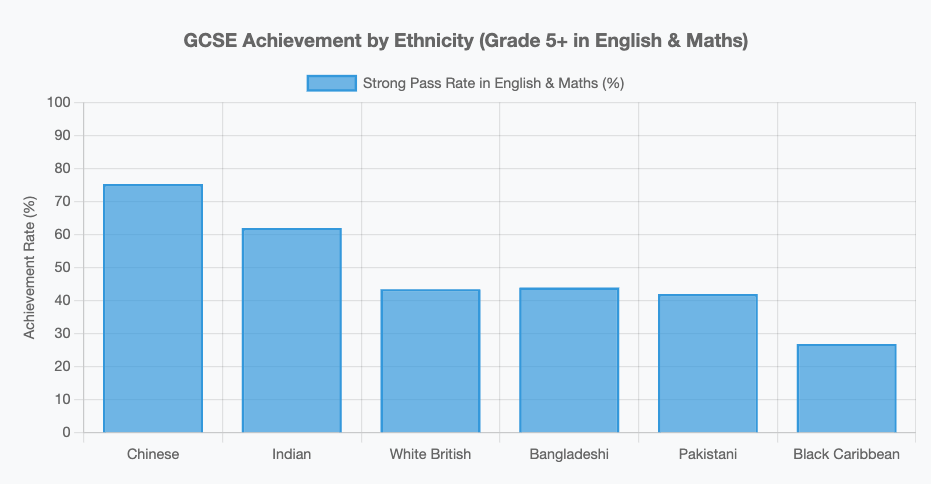
Indian and Hindu students are also overachievers in school – almost 3 in 10 students (28%) achieve 3 ‘A’ grades at A Level, a marker for how well Indian and Hindu students are outperforming the majority of their peers in the British education system.
Indians and Hindus also rank among the lowest for suspensions from school (122 pupils in 10,000) [8], suggesting that Indian students not only outperform their peers but also are disciplined and well-behaved.
They also display a strong propensity for higher education.
| Group | % with Level 4+ Qualification |
| Hindus | 54.8% |
| UK National Average | 33.8% |
Their participation rates in UK universities consistently exceed national averages, reflecting a deep-seated cultural emphasis on academic achievement. This trend is particularly evident in prestigious fields like medicine, dentistry, law, and engineering, where British Hindu and Indian students are highly represented. Data from HESA, alongside analyses of university enrolment statistics, demonstrates that British Indians are not only accessing higher education in significant numbers but also excelling in demanding academic programs. This commitment to advanced learning contributes significantly to the UK’s skilled workforce and professional sectors.
Health matters
87.8% of Hindus are in overall good or very good health condition [9]. Hindu scriptures are the founding pillars of holistic health practices like yoga, meditation, and the use of Ayurveda to promote good health. This good health reduces the burden on the NHS, saving the service and the country millions of pounds.
| Group | % in Good / Very Good Health |
| Hindus | 87.8% |
| UK National Average | 75.0% |
Figure 2: Percentage of “Good” or “Very Good” health of Hindus in England and Wales, Office for National Statistics, Census 2021
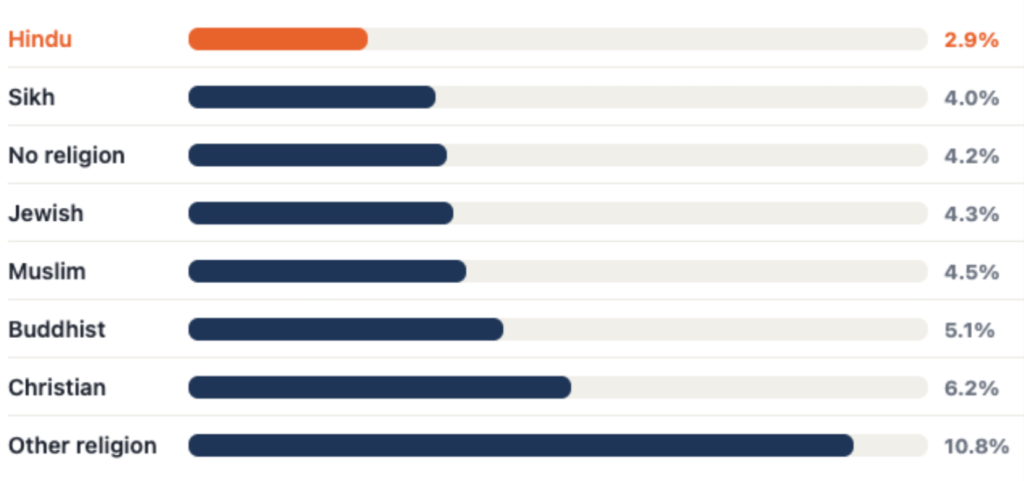
In addition to good overall health, Indians and Hindus are also active contributors to the health services in the UK. While Indians & Hindus account for less than 3% of the total UK population, it is estimated that they comprise at least 23% of hospital & community healthcare workers – 7 times their overall population. [10,11] According to the UK General Medical Council’s (GMC) 2023 workforce report, the total number of registered doctors in the UK who identified as Hindu was 8.3%. [12] In 2025, out of 409,986 doctors in the UK, Hindus made up 38,540; in other words, 9.4% of doctors in the UK identified as Hindu. This is the highest of all religious minorities in the UK per capita. [13]
State welfare benefits
According to the UK Census 2021 data, Indians have the second-lowest rate of receiving income-related benefits at just 8%, tied with Chinese families, compared to the UK average of 16%. This means they’re half as likely as the general population to receive means-tested benefits like housing support. [14]
4% of Indians are on Housing and Social benefits, whilst the UK average is 9%.
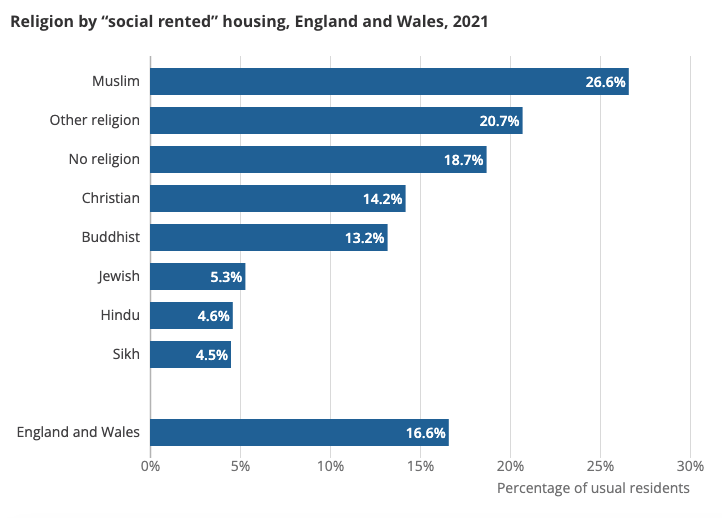
By religion, 4.6% of Hindus and 4.5% of Sikhs are claiming social housing benefits, making them the lowest group in the UK to be claiming social housing benefits. [15]
Law and order, armed forces and national security
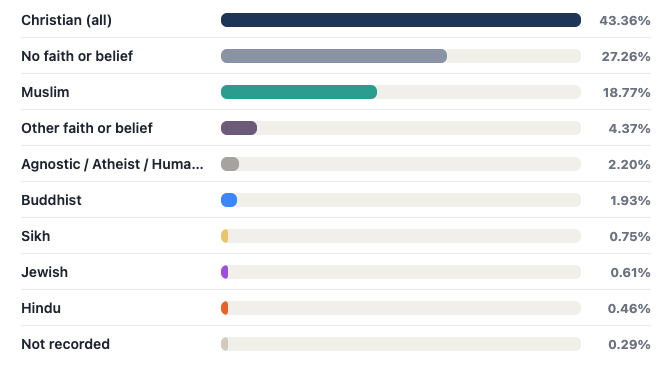
Indians and Hindus are generally model law-abiding citizens, with an arrest rate that is among the lowest out of all ethnic groups (4.5 people per 1000). They are not, as a community, involved with terrorism or subversive or antisocial activities and are disproportionately underrepresented in crime figures, compared to many other immigrant groups. The latest prison population statistics released in July 2026 reveal that Hindus constitute only 0.46% of the England and Wales prison population. [16]
In addition, Indians contribute well to the national law enforcement workforce. As of March 2024, in England & Wales, 1,870 (1.3%) of the Police workforce were of Indian ethnicity. [17]
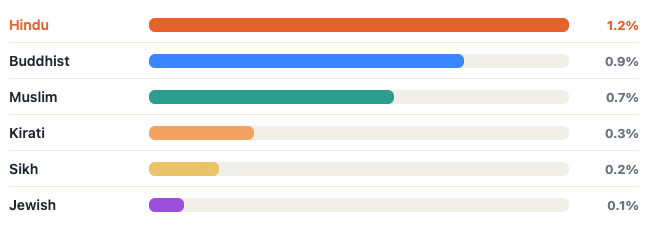
Furthermore, 1.24% of the UK Regular Armed Forces identify as Hindu [18], the largest of any religious minority group in Britain. There are, in addition to the number above and not included in the data, a further 1,500 (approximately) Hindu Gurkhas within the Brigade of Gurkhas.
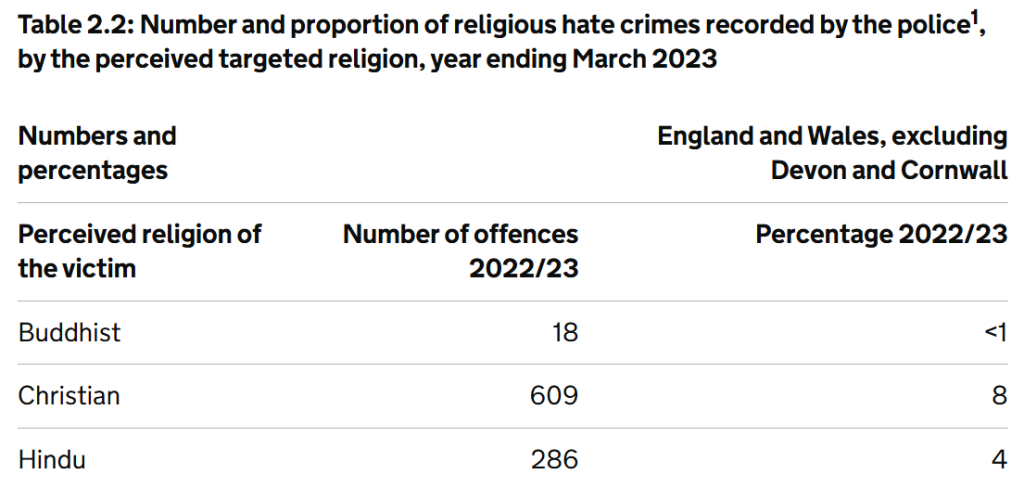
It is unfortunate that while Indians and Hindus in the UK exhibit disproportionately lower rates of criminal involvement, they are commonly the targets of religiously and racially motivated hate crimes. According to official government statistics for England and Wales in the year ending March 2023, Hindus were the victims of 286 recorded religious hate crimes, representing 4% of all such offences. The actual number is likely much higher, taking into account the large number of crimes that are not reported.
Indians and Hindus as models of good immigration
These data begin to tell the story of how Indians and Hindus contribute to Britain, and in many ways are a great example of what good immigration looks like.
Research carried out in 2018 estimated that Indians and Hindus (less than 3% of the total UK population) contribute approximately 6% to the GDP of the United Kingdom. This is twice the expected and in sharp contrast to some other groups. Beyond individual contributions made by British Indians and British Hindus, the UK-India relationship has evolved into a powerful partnership, with Indian companies employing 116,000 people, paying almost half a billion in corporation tax and turning over £50 billion in the UK.
Apart from the economic and professional contribution by Indians and Hindus in the UK, there is good evidence that, as a group, they are one of the best integrated immigrant groups in British society.
Current public and political discourse is painting all forms of immigration as negative. While it is important to discuss the problems associated with uncontrolled illegal immigration to the UK, it is important to highlight that Hindu and Indian immigration has contributed to British society very positively and needs to be recognised and appreciated.
References
- Office for National Statistics – Census 2021: Ethnic group, England and Wales
- Office for National Statistics – Census 2021: Religion in England and Wales
- Office for National Statistics – Census 2021: Religion by economic activity, England and Wales
- UK in a Changing Europe – ukandeu.ac.uk
- Office for National Statistics – Census 2021: Religion by housing, health, employment, and education, England and Wales
- Office for National Statistics – Annual population survey (APS) QMI and UK Government: Ethnicity and type of Occupation
- Office for National Statistics – Census 2021: Religion by housing, health, employment, and education, England and Wales
- UK Government: Ethnicity facts figures – Pupil exclusions, 2023
- Office for National Statistics – Census 2021: Religion by housing, health, employment, and education, England and Wales
- Office for National Statistics – Census 2021: Religion by housing, health, employment, and education, England and Wales
- General Medical Council (GMC), 2025
- Workforce Report 2023, General Medical Council (GMC) https://www.gmc-uk.org/cdn/documents/workforce-report-2023-full-report_pdf-103569478.pdf
- General Medical Council (GMC), 2025
- Office for National Statistics – Census 2021: Ethnic group, England and Wales
- Office for National Statistics – Census 2021: Religion by housing, health, employment, and education, England and Wales
- Ministry of Justice, Offender Management Statistics Quarterly, Table 1_Q_8, published 30 July 2026
- UK Government: Ethnicity facts figures – Police workforce, 2025
- UK Ministry of Defence – UK Armed Forces Biannual Diversity Statistics April 2026
Other References
- Office for National Statistics (2022). Religion, England and Wales: Census 2021.
- Office for National Statistics (2024). Indian population in the UK – Freedom of Information Request.
- Wikipedia (2025). Hinduism in the United Kingdom.
- Pew Research Center (2016). The education gap between Hindus in India and the West.
- Hindu Council UK (2020). Written evidence submitted to Parliament (MRS0178)
- Hindu Matters in Britain. Economy.
- UK Parliament Research Briefings (2024). UK Prison Population Statistics (SN04334).
- Indiaspora (2024). Rise of the ‘Brown Pound’: Indian entrepreneurship blossoms in the UK.
- Department for Education (2014). Ethnicity, deprivation and educational achievement at age 16. Retrieved from UK Government publication RR439B.
- Hindus for Democracy UK. United Kingdom Information Page.
- Sociology Institute (2025). The Indian Influence in the UK: Beyond Curry and Culture.
- India Global Business (2019). Several generations of Indians have enhanced UK’s diversity.