Britain’s future depends not only on the strength of its economy, the quality of its public services, and the effectiveness of its laws, but also on the values that inspire individuals to contribute to the common good. In an increasingly diverse society, a vital question commands attention: what can established communities teach us about responsible citizenship, social cohesion, and the relationship between personal success and collective well-being?

The British Hindu community offers a compelling perspective. Its contribution is visible across professional life, entrepreneurship, education, healthcare, family life, voluntary service, and civic participation. Behind these contributions lies a philosophical tradition developed over millennia – one that emphasises duty, self-discipline, learning, service, respect for diverse paths, and the welfare of society.
This perspective highlights a tradition whose ethical principles carry profound practical relevance for modern British life, offering a blueprint for how cultural heritage can function as a powerful public asset.
The philosophy of duty: Roots of civic responsibility
The self-reliance and law-abiding nature of the Hindu diaspora is no accident of geography; it is the natural outcome of a duty-based worldview. Where contemporary Western culture often centres primarily on individual rights, traditional Hindu philosophy centres on Dharma – the absolute obligation of moral duty, social order, and righteous conduct toward family, community, and the wider state.
Respect for diversity and freedom of thought
A core feature of Hindu philosophy is its long-standing engagement with different understandings of truth and reality. The Rig Veda (1.164.46) contains the celebrated verse:
“Ekaṁ sat viprāhā bahudhā vadanti.”
“Truth is one; the wise describe it in different ways.”
This tradition fosters intellectual humility, acceptance and respect for differing beliefs & views: human beings approach profound questions through varied perspectives, and disagreement need not lead to hostility. For a plural democracy, this reinforces the principle that freedom of conscience and respectful disagreement are core strengths of a cohesive society.
Duty, lawfulness, and self-Discipline (Dharma)
The concept of dharma translates as duty, righteousness, or conduct appropriate to one’s responsibilities. It asks individuals to consider not only their rights, but how their actions affect others. The Bhagavad Gita (3.20) emphasises performing one’s duties rather than acting solely for personal reward:
“Karmaṇaiva hi saṁsiddhim āsthitā janakādayaḥ, loka-saṅgraham evāpi paśyan kartum arhasi.”
“King Janaka and others attained fulfilment through action; one should also act with the welfare and well-being of society in view.”
This worldview yields a citizen who understands that personal freedom comes paired with responsibility to family, neighbours, institutions, and the wider public.
Service without expectation of reward (Seva)
The Sanskrit word seva denotes selfless service. In Hindu tradition, serving others is a moral and spiritual responsibility. The concept of loka-sangraha – acting for the maintenance, welfare, and cohesion of the world – bridges individual effort and public benefit. Whether through mentoring, supporting local charities, or caring for the vulnerable, seva transforms voluntary effort into a pillar of social infrastructure.
Education, family, and intergenerational responsibility
Learning and the transmission of knowledge are central pillars of Hindu life. The Taittiriya Upanishad (1.11.2) instructs students with the timeless guidance:
“Mātṛdevo bhava. Pitṛdevo bhava. Ācāryadevo bhava. Atithidevo bhava.”
“Regard your mother, father, teacher, and guest with the highest respect.”
This teaching links respect for family with respect for education and hospitality, fostering high educational aspirations, strong parental involvement, and resilient multi-generational care networks.
Ethical leadership and public welfare
Rooted in texts like Kauṭilya’s Arthaśāstra (1.19.34), governance and personal accountability are viewed through the lens of public welfare:
“Prajā-sukhe sukhaṁ rājñaḥ, prajānāṁ ca hite hitam.”
“The ruler’s happiness lies in the happiness of the people, and the ruler’s welfare in their welfare.”
Authority exists to serve the public, aligning ethical purpose with administrative competence, financial discipline, and the rule of law.
By the numbers: Empirical evidence of civic contribution
Philosophical principles find tangible expression in official data. The 2021 Census of England and Wales, published by the Office for National Statistics (ONS), alongside official Ministry of Justice and General Medical Council records, provides an empirical profile of the British Hindu community.
| Metric | British Hindu Figure |
| Level 4+ Higher Education | 54.8% |
| Employed in Professional Roles | 34.3% |
| Economic Activity Rate | 64.4% |
| Social Rented Housing | 4.6% |
| UK (England & Wales) Prison Population Share | 0.4% |
Sources: ONS Census 2021, Ministry of Justice (June 2025)
Educational attainment and professional life
Among people identifying as Hindu aged 16 and over in Census 2021, 54.8% held a Level 4 or above qualification, compared to 33.8% of the overall population of England and Wales. Furthermore, 34.3% of employed Hindus worked in professional occupations – spanning medicine, law, engineering, and education – translating into high-value contributions across Britain’s economic and healthcare sectors.
Financial independence and housing
Reflecting a strong culture of self-reliance and enterprise, only 4.6% of British Hindus lived in social rented housing at the 2021 Census, compared to 16.6% nationally. High workforce participation and tax compliance make the community a robust net economic contributor.
Law and order
Official prison population data from the Ministry of Justice shows that in June 2025, 356 prisoners identified as Hindu – representing approximately 0.4% of the prison population, against a general Hindu population share of 1.7%. While multiple socioeconomic factors influence these figures, this low representation reflects the strong cultural emphasis on family support, personal accountability, and respecting the law of the land.
Integration without friction or entitlement: A blueprint for social cohesion
A critical dimension of the Hindu migration experience is how the community engages with Britain’s civic architecture.
A foundational maxim of classical Hindu thought, drawn from the Taittiriya Upanishad, is summarised in the ethical imperative to “Satyam Vada, Dharmam Chara” (“Speak the truth, abide by the law of the land”). Upon settling in Britain, Hindu families have consistently adopted local laws, customs, and responsibilities without seeking to alter the fundamental fabric of British institutions.
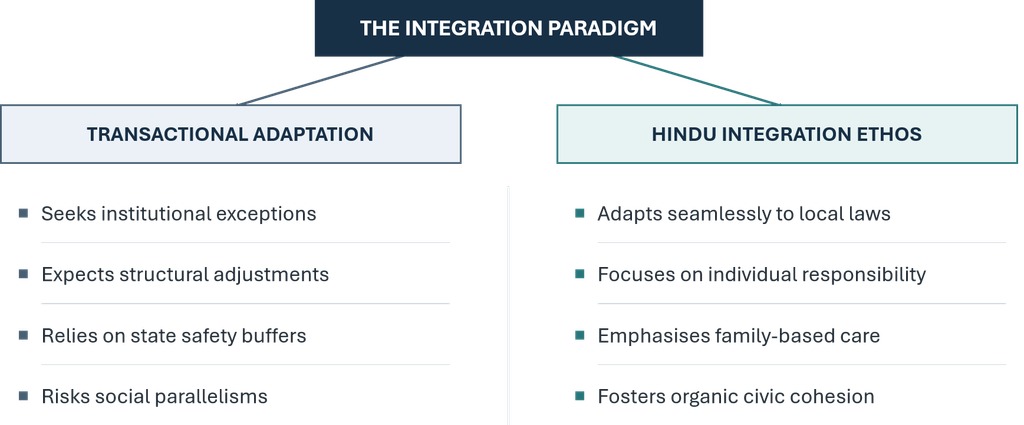
This reflects a vital distinction between integration and multicultural accommodation. Integration enables people to participate fully in shared civic life without requiring them to abandon every inherited custom, language, or religious tradition. A Hindu family can celebrate Diwali, visit a mandir, and teach children Sanskrit prayers while remaining completely committed to British law, public institutions, and democratic responsibilities.
Crucially, the community does not engage in lobbying efforts to demand exemptions from national regulations or expect public bodies to compromise core standards. They seek fair and lawful accommodations where necessary, but recognise that a healthy society balances cultural respect with adherence to shared public standards. This approach reflects the ancient Vedic concept Ekaṁ sat viprāhā bahudhā vadanti (“Truth is One, the wise speak of it in many ways”). Because Hindu philosophy intrinsically accepts pluralism and respects diverse paths, its adherents hold no theological drive to project their beliefs onto surrounding society. They do not present demands; they offer steady participation and quiet solutions. They do not present themselves as a problem to be managed; they act as active partners in solutions.
The world is one familty
The trajectory of the British Hindu community demonstrates that preserving cultural identity and achieving successful civic integration are entirely complementary.
By valuing educational discipline, honouring public order, practising self-funded charity (seva), and prioritising duty over entitlement, British Hindus offer a powerful template for modern citizenship. As the ancient Mahā Upaniṣad (6.72) concludes:
“Vasudhaiva kuṭumbakam”
“The world is one family.”
This outlook encourages individuals to widen their circle of concern – caring for families while serving neighbourhoods, preserving ancient traditions while respecting adopted laws, and building successful enterprises while contributing to the common prosperity of the nation they call home.
Does the Hindu ethos of duty, self-reliance, and quiet contribution offer a viable blueprint for building a more cohesive modern society? Are there other community models and policy approaches that have worked as well?