India has always been a land of multitudes. From the climates to the wildlife, from the cuisines to the customs, the diversity and multiplicity of this land have always fascinated the World. One of the important aspects of this diversity has been the innumerable communities of this country.
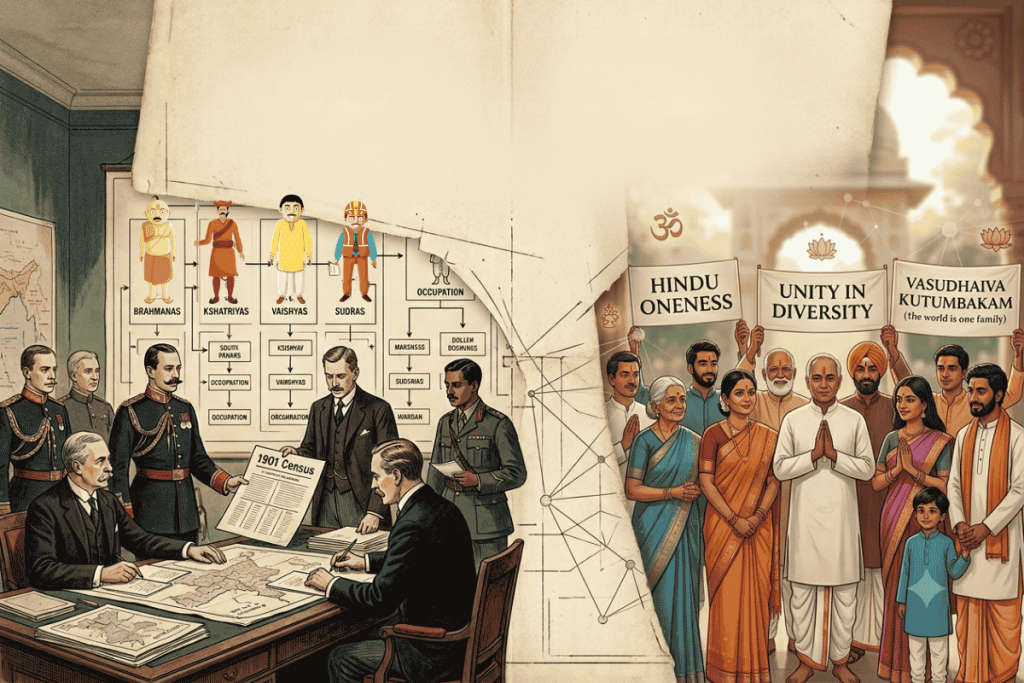
The word caste itself originated from the Spanish and Portuguese word, casta, which means breed, race or lineage and implies purity. It was used by Portuguese seafarers when they landed in India in the 15th century and was further exploited by the British colonisers in their strategy of ‘divide and conquer’. Encompassing the multilayered ramifications of this deliberate hierarchical classification is beyond the scope of this article; we aim to empower the reader with its historical basis and its ruthless efficacy in still dividing society in current times.
Historically, Bharat’s (India’s) society was based on a symbiotic relationship between the 4 Varnas (there isn’t any equivalent English word for this Sanskrit word, and therefore, it has been incorrectly associated with the word caste). The 4 Varnas meant 4 types of attribute composition, which make a certain individual fit for specific tasks. For instance, some people were naturally born with an athletic, muscular build, making them favourable for succeeding in areas such as the military, law enforcement, security and sports. While this doesn’t imply their lack of intellect, their athletic ability far overpowered their intellectual abilities, which made them a natural fit in the areas above. These were called Kshatriyas. Similarly, there were some people born with an innate talent for business and sales who could make excellent use of natural resources and turn them into finished products. These became the merchants, traders, and businessmen collectively called Vaishyas. Then there were those who were the exact complement to the Kshatriyas, wherein their intellectual ability was much superior to their business acumen or physical strength. These became the Brahmanas who invented an oral tradition of memorising hundreds of thousands of sacred texts as well as maintaining the protocols for ritualistic worship. Last but not least, those who had an admixture of all the above qualities but none at the highest potential became the Sudras. They basically formed the backbone of the service industry at the time and were employed widely by the Vaishyas for a variety of professions. This led to a natural evolution of specialised skills, and the Sudras were further divided into Potters, Blacksmiths, Weavers, Cattle Herders, etc.
The British Raj systematically weaponised caste through a “Divide and Rule” strategy, most notably when colonial administrator Herbert Hope Risley formalised rigid hierarchies in the 1901 Census using scientific racism to categorise the entire Hindu population. A key tool of political suppression was the 1871 Criminal Tribes Act, which labelled over 150 communities, often those most loyal to India or rebellious against colonial rule, as “born criminals” to justify their marginalisation. This administrative passion for pigeonholing replaced a historically fluid social structure with rigid boundaries designed to keep the population divided and easier to govern, preventing them from rising up against the British and keeping them quarrelling amongst themselves.
Strategic divisions were further entrenched through the “Martial Race” theory, which rewarded groups deemed loyal to the Raj, while intentionally denying recruitment to some communities, who were viewed as the primary instigators of the 1857 uprising. The British also utilised the Punjab Land Alienation Act to fracture communal ties and worked to sever Sikhs from their Hindu brothers. These colonial acts and historic decisions effectively manufactured permanent political wedges between communities that had previously shared a fluid, syncretic heritage.
If we take a bird’s-eye view of India’s society before these colonial invasions, leaving aside biases, the Vaishyas were single-handedly responsible for wealth and employment generation. In fact, there are historical records wherein the amassed wealth was so much that the Vaishyas used to donate huge sums back to societal welfare. The Kshatriyas, with their might and power, became the kings and Rajas of the time, and their lineages defended the borders of the kingdom. The Brahmanas maintained the temples with the required rituals, while the funds came from the Vaishyas, Kshatriyas/Rajas. Ultimately, all the executive and service-based roles were done by the Sudras and at times, they also assumed the thrones of quite a few kingdoms. If you remove either of these types from society, it will disrupt harmony in society. Even in current times, regardless of the labels, we see a natural organisation which occurs similarly. There wasn’t any issue of hierarchy or supremacy among these Varnas. The reason for this assertion is an inference: if the Bharatiya (Indian) society wasn’t harmonious in this way, the prosperity, health, wealth, knowledge, culture, architecture, trade and nature wouldn’t have been in the abundance that attracted the colonisers.
Why is this discussion relevant in current times? Why should a supposedly age-old system of class division play a role in aspects of discrimination or any other issue, for that matter? We’ll explore how this system was twisted during the colonial era and how its twisted incarnation has been employed for latent yet nefarious purposes another time – watch this space.